



In 2026, securing the most competitive financing for an Alberta property requires navigating a dynamic economic landscape where five-year fixed terms currently range from 4.04% to 5.49%, and variable options start at 4.1%. With the Bank of Canada maintaining its overnight lending rate at 2.75%, borrowers must carefully evaluate their financial profiles against shifting bond yields, localized housing inventory, and aggressive lender discounts. Choosing the optimal loan structure can save homeowners upwards of $18,000 in interest over a standard five-year term, making strategic comparison and market timing absolutely essential for prospective buyers.
Key Takeaways
- Current Market Averages: Five-year fixed agreements sit between 4.04% and 5.49%, while variable products remain highly competitive at 4.1%.
- Economic Drivers: The Bank of Canada’s 2.75% overnight rate and fluctuating five-year government bond yields directly dictate lender pricing models.
- Down Payment Impact: High-ratio insured mortgages (under 20% down) often secure lower interest percentages due to reduced lender risk.
- Lender Diversity: Alberta’s market features significant variance between national banks, regional credit unions, and alternative lending institutions.
- Strategic Timing: Monitoring inflation reports and central bank announcements can provide a critical advantage before locking in a term.
The 2026 Alberta Real Estate and Financing Landscape
Alberta’s property sector has entered a period of balanced stabilization. Recent data reveals a cooling trend that offers buyers unprecedented negotiating power. While overall provincial home sales normalized in early 2026, average property prices have climbed to $542,698. This represents a sustained demand driven by interprovincial migration and robust provincial employment metrics.
According to the Statistics Canada Q1 2026 economic report, Alberta’s population growth continues to outpace the national average, creating both opportunities and complexities in the housing sector. Housing inventory has expanded province-wide, particularly in master-planned communities surrounding Calgary and Edmonton, where balanced markets create stable opportunities for buyers.
The sales-to-new-listings ratio currently sits at 61%, signaling a gradual shift toward buyer-friendly dynamics. As inventory expands, financial institutions are competing more actively for qualified applicants. This heightened competition directly translates into better financing terms, provided buyers know how to leverage their financing options for Alberta homes effectively.
“The 2026 Alberta market presents a unique window for homebuyers. With lenders aggressively competing for market share amidst stabilizing property values, borrowers who present strong financial profiles can negotiate terms significantly below posted averages.” — Dr. Michael Chen, Senior Housing Economist at the Canadian Real Estate Association.
Fixed vs. Variable: Navigating Your Options
Choosing between a fixed and variable agreement is arguably the most consequential financial decision a homebuyer will make. Each option responds differently to macroeconomic shifts, making it crucial to align your choice with personal risk tolerance and long-term financial objectives.
The Stability of Fixed-Term Agreements
Fixed terms lock in your interest percentage and monthly payment amount for the duration of the contract. In 2026, the popular five-year fixed option provides a safeguard against potential economic volatility. This predictability is invaluable for households that need to plan long-term budgets without the threat of payment shocks.
Fixed products track closely with five-year Canadian government bond yields. When institutional investors demand higher yields from government bonds, lenders subsequently raise fixed-rate offers to maintain their profit margins. Monitoring these bond markets provides a reliable leading indicator for where fixed terms are heading.
The Flexibility of Variable Products
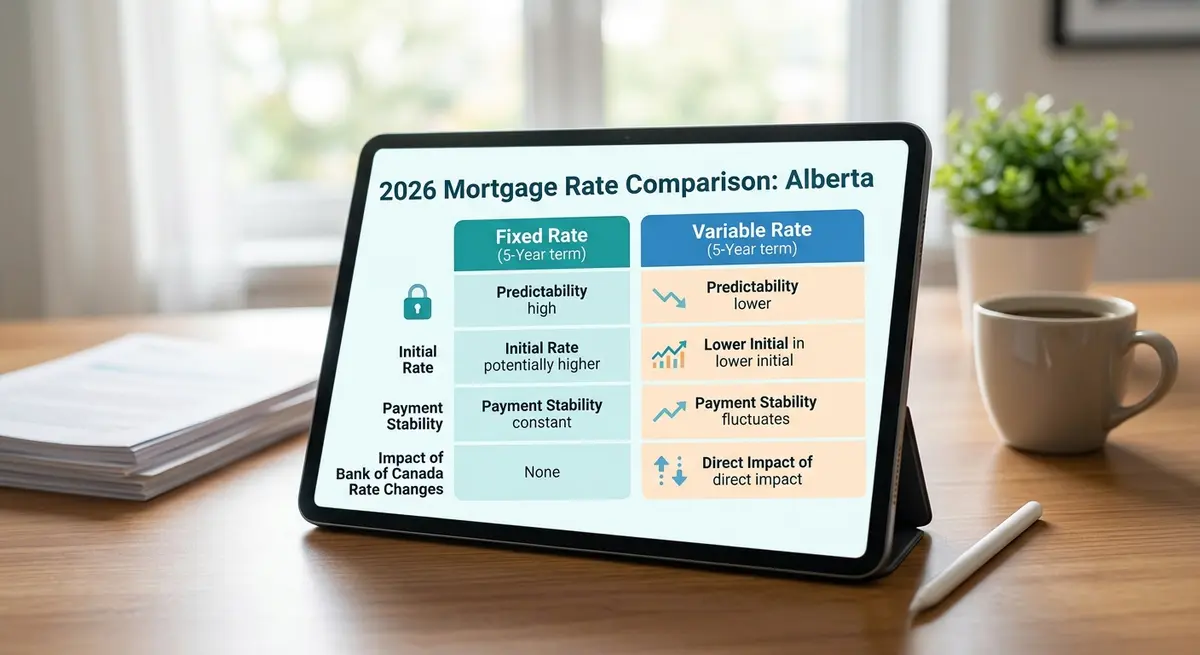
Variable agreements fluctuate in tandem with the Bank of Canada’s prime lending rate. While they carry inherent risk, they historically cost less over the life of a 25-year amortization period. In the current 2026 climate, variable products starting at 4.1% offer immediate monthly savings compared to their fixed counterparts.
| Feature | 5-Year Fixed Rate | 5-Year Variable Rate |
|---|---|---|
| Current 2026 Range | 4.04% – 5.49% | 4.10% – 4.85% |
| Payment Stability | Payments remain identical for the entire term. | Payments or principal allocation may fluctuate. |
| Economic Driver | Government Bond Yields | Bank of Canada Overnight Rate |
| Early Break Penalty | Typically the greater of 3 months interest or Interest Rate Differential (IRD). | Usually limited to 3 months of interest. |
| Best Suited For | Risk-averse buyers, strict budgeters, first-time owners. | Investors, buyers planning to sell short-term, risk-tolerant borrowers. |
Many Albertans are currently opting for hybrid approaches or shorter 2-to-3-year fixed terms, blending short-term security with future adaptability. Analyzing how rate changes could impact your total debt servicing over time is a critical component of Alberta real estate market analysis.
Crucial Factors That Determine Your Approval Terms
Financial institutions do not offer their lowest advertised percentages to every applicant. Your specific financial profile and the details of the property you intend to purchase create a customized risk scenario for the lender. Understanding these variables allows you to optimize your application.
Credit Health and Debt Service Ratios
A credit score above 680 is generally the threshold for accessing preferred A-lender rates in Canada. Lenders view this metric as the primary indicator of reliable repayment habits. Furthermore, underwriters scrutinize your Gross Debt Service (GDS) and Total Debt Service (TDS) ratios. In 2026, most prime lenders require a GDS below 39% and a TDS below 44%.

Down Payments and Loan-to-Value (LTV) Ratios
The size of your down payment plays a dual, sometimes counterintuitive, role in rate determination. Deposits of 20% or more allow buyers to avoid mandatory default insurance premiums. However, these uninsured mortgages often come with slightly higher interest percentages.
Conversely, buyers putting down less than 20% must purchase default insurance through providers like the Canada Mortgage and Housing Corporation (CMHC). Because the lender is protected against default, they frequently offer their absolute lowest rates to these high-ratio borrowers. First-time buyers exploring first-time buyers exploring new construction often utilize these insured plans to balance upfront capital retention with long-term interest savings.
Property Usage and Amortization
The intended use of the property significantly influences the terms offered. Primary residences receive the most favorable pricing. Investment properties or secondary homes typically face a premium of 0.25% to 0.50% due to perceived elevated risk during economic downturns. Additionally, opting for a shorter amortization period (e.g., 20 years instead of 25) can sometimes unlock better uninsured rate offers.
National Banks vs. Provincial Credit Unions
Alberta’s financial ecosystem presents homebuyers with a wide spectrum of lending solutions. From massive national institutions to community-focused credit unions, borrowers can access tailored capital strategies that align with their unique circumstances.
The Big Six Canadian Banks
Major national banks dominate the industry with extensive digital tools, multi-product bundling discounts, and robust infrastructure. These institutions appeal to those prioritizing convenience and integrated financial services. Their standardized underwriting processes are highly efficient for W-2 employees with pristine credit and traditional income sources.
Alberta Credit Unions and Regional Lenders
Regional players often provide superior flexibility. Local credit unions frequently offer competitive terms by considering localized economic factors rather than rigid national algorithms. This localized approach is particularly beneficial for self-employed applicants, agricultural workers, or buyers interested in rural properties.
Credit unions emphasize member benefits through personalized underwriting, community reinvestment programs, and profit-sharing dividends. Furthermore, utilizing a licensed broker can streamline comparisons across 30+ lenders, leveraging volume discounts that are entirely unavailable to individual retail shoppers.
Step-by-Step Guide to the Application Process
Securing favorable financing is a methodical process. Navigating the construction loan process or standard residential financing requires preparation and strategic timing.
- Document Gathering: Compile two years of T1 Generals, Notice of Assessments (NOAs), recent pay stubs, and 90 days of bank statements proving the source of your down payment.
- Secure a Pre-Approval: Before house hunting, obtain a pre-approval to lock in current rates for 90 to 120 days. This protects you against sudden bond yield spikes while you shop.
- Property Valuation: Once you have an accepted offer, the lender will conduct an appraisal to ensure the purchase price aligns with current market values.
- Final Underwriting: The lender’s underwriting team verifies all property details, finalizes your debt ratios, and issues a formal mortgage commitment letter.
- Legal Finalization: You will meet with a real estate lawyer to sign the final documents, register the title, and pay applicable closing costs.

Economic Indicators Shaping Future Rate Trends
Mortgage terms do not exist in a vacuum; they are shaped by powerful macroeconomic forces. Global markets and domestic fiscal policies create ripple effects that directly impact the cost of borrowing in Alberta.
The Bank of Canada’s mandate to keep inflation near the 2% target is the primary driver of the overnight rate. Following a series of aggressive adjustments in previous years, the 2026 stabilization provides much-needed predictability. However, Alberta’s energy-centric economy makes it uniquely sensitive to international shifts. Commodity price swings, U.S. trade policies, and global inflation trends all influence investor confidence and currency valuation.
According to the Bank of Canada, stronger American economic performance often pulls capital south, potentially forcing Canadian interest rates higher to remain competitive. Staying informed about these macroeconomic indicators allows savvy buyers to time their applications strategically, potentially saving hundreds of dollars on their monthly payments.
Regional Market Variations Across the Province
While national economic policies set the baseline, current housing trends dictate that hyper-local factors influence final lending decisions. Alberta’s vast geography means that property valuations and lender risk assessments vary significantly between municipalities.
In major urban centers like Calgary and Edmonton, high liquidity and rapid property turnover make lenders highly comfortable, resulting in the most competitive rate offerings. Conversely, financing a property in smaller municipalities or rural areas may require larger down payments or slightly higher interest premiums due to longer average days-on-market and specialized property types (such as acreages or properties with well/septic systems).
Understanding these regional nuances is a vital part of mastering property transactions in the province. Buyers relocating from urban to rural settings should consult with brokers who specialize in regional lending guidelines to avoid unexpected financing hurdles.
Frequently Asked Questions
What is the average mortgage rate in Alberta right now?
As of 2026, the average five-year fixed mortgage rate in Alberta ranges between 4.04% and 5.49%. Variable rates are currently starting around 4.1%, depending on the borrower’s creditworthiness and down payment size.
Why are insured mortgage rates lower than uninsured rates?
Insured mortgages (where the buyer puts down less than 20%) are backed by default insurance from agencies like the CMHC. Because the lender faces virtually zero risk of financial loss if the borrower defaults, they can offer their absolute lowest interest rates.
How long does a mortgage pre-approval last?
A standard mortgage pre-approval in Canada typically guarantees your quoted interest rate for 90 to 120 days. If rates go up during this period, you keep your lower locked rate; if they go down, you can usually negotiate the new, lower rate.
Can I switch from a variable to a fixed rate later?
Yes, most variable-rate mortgages in Alberta include a conversion feature that allows you to lock into a fixed term at any point without paying a financial penalty. However, you must accept the lender’s current fixed rate at the time of conversion.
How does my credit score affect my mortgage application?
Your credit score determines both your eligibility and your rate. A score above 680 is generally required for the best rates from A-lenders, while scores below 600 may require you to use alternative B-lenders, which charge higher interest premiums.
What are the penalties for breaking a mortgage early in Alberta?
For variable mortgages, the penalty is typically three months of interest. For fixed mortgages, the penalty is usually the greater of three months’ interest or the Interest Rate Differential (IRD), which can amount to tens of thousands of dollars depending on current market conditions.
Conclusion
Navigating the 2026 Alberta mortgage market requires a strategic blend of economic awareness, financial preparation, and professional guidance. Whether you are a first-time buyer looking to enter the market or a seasoned investor expanding your portfolio, understanding the mechanics behind fixed and variable rates, the impact of your credit profile, and the diverse lender landscape is paramount. By taking a proactive approach to your financing, you can secure terms that not only fit your immediate monthly budget but also align with your long-term wealth-building goals. If you are ready to explore your financing options and secure the best possible terms for your next property, contact our team today for a personalized consultation.


