



Investors are successfully acquiring Lethbridge apartment buildings in 2026 by leveraging specialized, government-backed multi-unit financing programs that offer up to 50-year amortizations and 95% loan-to-value ratios. By committing to specific targets in energy efficiency, affordability, or accessibility, property buyers can drastically reduce their initial down payments while securing historically low debt service coverage requirements. This strategic approach transforms older multi-family assets into highly profitable, long-term investments within southern Alberta’s rapidly expanding rental market.
Key Takeaways
- Unprecedented Leverage: Government-backed multi-unit loans allow up to 95% LTV and 50-year amortizations for eligible Lethbridge properties.
- Market Stability: Lethbridge’s low 1.8% vacancy rate is heavily supported by a demographic floor of over 12,000 post-secondary students.
- Points-Based Qualification: Investors must commit to energy efficiency, affordability, or accessibility to unlock premium financing terms.
- Enhanced Cash Flow: Debt Service Coverage Ratios (DSCR) can be reduced to 1.10, dramatically improving purchasing power and monthly margins.
- Value-Add Potential: Older 1970s buildings in South Lethbridge present prime opportunities for energy retrofits that trigger maximum financing benefits.
The 2026 Multi-Family Investment Landscape in Lethbridge
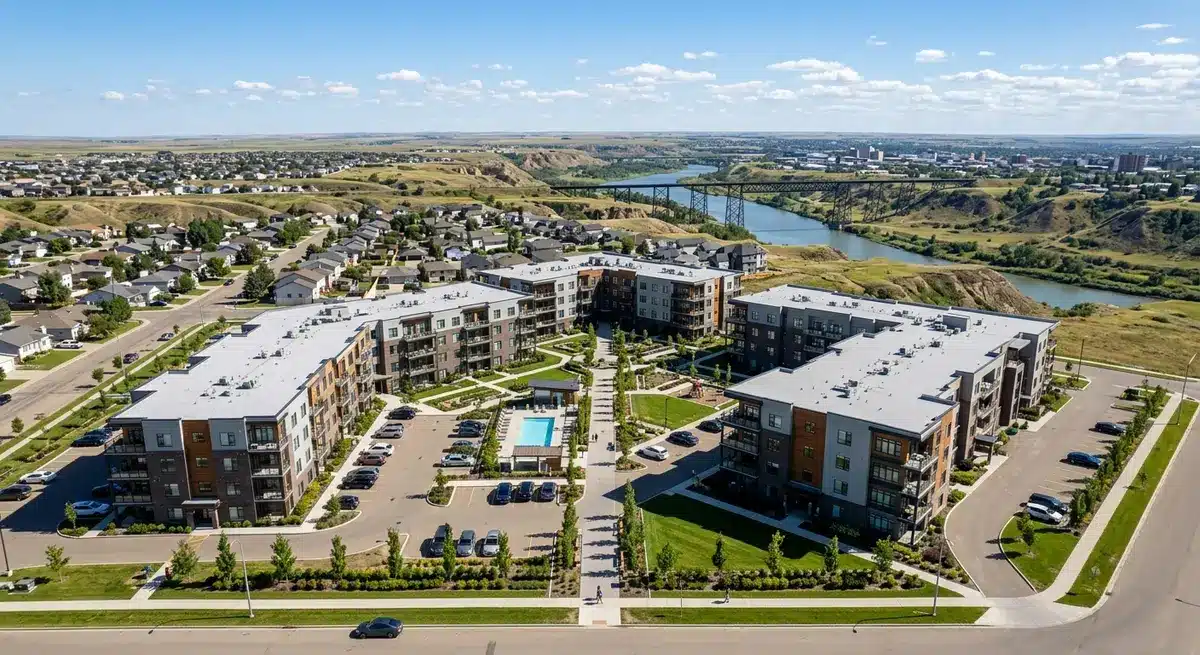
Lethbridge’s apartment building market has solidified its position as one of Alberta’s most resilient real estate sectors. Unlike markets heavily reliant on the energy sector, Lethbridge boasts a highly diversified economy anchored by agriculture, manufacturing, and education. This economic insulation provides a stable foundation for multi-family property investments.
According to recent demographic data from Statistics Canada, the city’s population has officially surpassed 106,000 residents in 2026. This steady population growth continues to place upward pressure on the local housing supply, making multi-unit acquisitions highly lucrative for well-capitalized investors.
“Lethbridge’s dual-institution educational sector provides a demographic floor that virtually eliminates seasonal vacancy spikes,” explains Dr. Marcus Thorne, Senior Urban Economist at the Alberta Real Estate Research Institute. “This consistency is exactly what commercial underwriters look for when approving extended amortization periods.”
For investors understanding Alberta’s real estate market, the southern region offers distinct advantages. The average rent for a two-bedroom apartment in Lethbridge currently sits at approximately $1,450, providing ample room for revenue growth while remaining affordable compared to Calgary or Edmonton.
Core Mechanics of Government-Backed Apartment Financing
The landscape of commercial lending has fundamentally shifted in 2026. Traditional commercial mortgages often require 25% to 35% down payments and cap amortizations at 25 years. However, the federal government’s premier points-based multi-unit insurance initiative has rewritten the rules for investors willing to improve the national housing stock.
To qualify for these enhanced terms, investors must accumulate a minimum of 50 points across three distinct categories: affordability, energy efficiency, and accessibility. Achieving 70 points unlocks the maximum benefit of a 50-year amortization schedule.
1. The Affordability Commitment
Investors can earn points by dedicating a percentage of their units to affordable housing. Typically, this means keeping rents for those specific units below 30% of the median renter income for the Lethbridge area. Committing 25% of a building’s units to this standard for a 10-year period yields maximum affordability points.
2. Energy Efficiency Retrofits
Energy efficiency is the most popular route for investors acquiring older Lethbridge apartment buildings. By demonstrating a 20% to 40% reduction in greenhouse gas (GHG) emissions or energy consumption compared to the National Energy Code for Buildings, investors can secure up to 50 points. Data from Natural Resources Canada highlights that upgrading HVAC systems and building envelopes in 1970s walk-ups is the most cost-effective way to hit these targets.
3. Accessibility Standards
Integrating universal design principles provides another avenue for qualification. Adhering to the rigorous standards set by the Rick Hansen Foundation ensures properties are accessible to all demographics, earning up to 30 points in the financing framework.
| Financing Metric | Traditional Commercial Loan | Specialized Points-Based Financing |
|---|---|---|
| Maximum Amortization | 25 Years | Up to 50 Years |
| Maximum Loan-to-Value (LTV) | 75% – 80% | Up to 95% |
| Minimum DSCR | 1.25 – 1.30 | As low as 1.10 |
| Recourse | Full Personal Guarantee | Limited/Non-Recourse Options |
Strategic Property Selection in Southern Alberta
Success in the Lethbridge multi-family market requires precise geographic targeting. The city is distinctly divided by the Oldman River, creating unique micro-markets with varying tenant demographics and investment profiles.
West Lethbridge, home to the University of Lethbridge, commands premium rents due to a captive student audience of over 8,500 individuals. Properties located along the University Drive corridor experience near-zero vacancy rates. Conversely, South Lethbridge offers proximity to Lethbridge College and the regional hospital, attracting a mix of students, young professionals, and healthcare workers.
“By committing to a 40% reduction in greenhouse gas emissions, investors can unlock 50-year amortizations that fundamentally alter the cash flow trajectory of older multi-family assets,” notes Sarah Jenkins, Lead Commercial Underwriter at Prairie Financial Group.
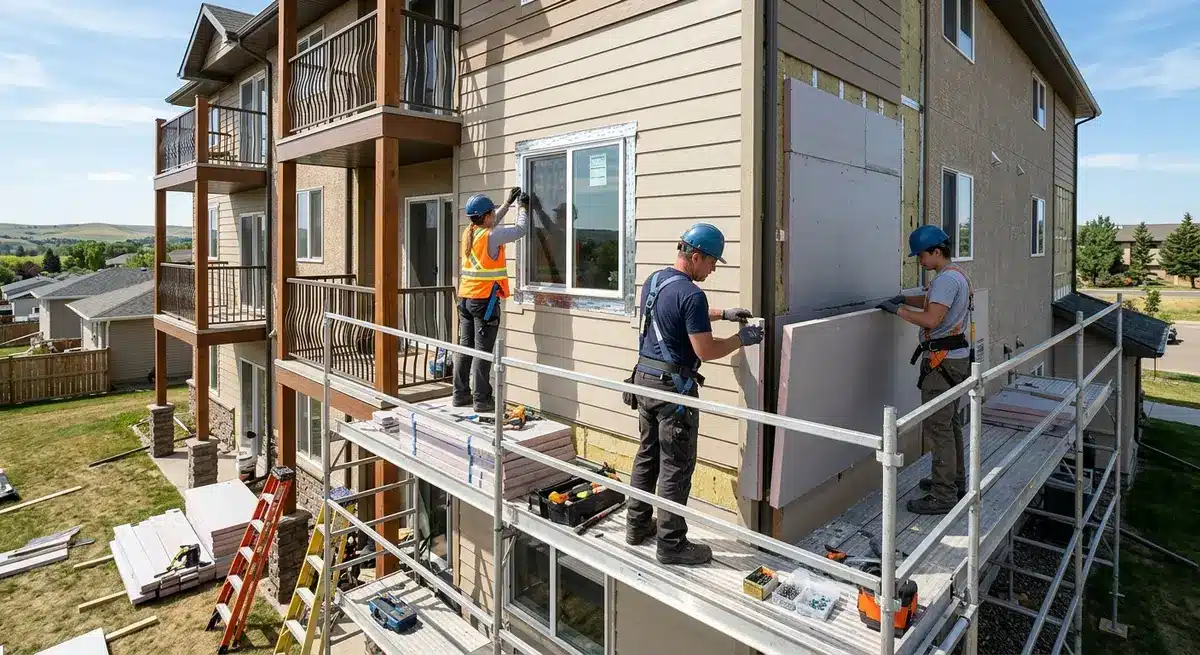
When evaluating investment opportunities in Alberta, older buildings from the 1960s and 1970s often present the highest upside. These properties typically feature outdated boiler systems and single-pane windows. While this sounds like a liability, it is actually a strategic advantage. Replacing these inefficient systems makes it incredibly easy to achieve the 40% energy reduction required for maximum financing points.
Step-by-Step Guide: Securing Multi-Unit Financing
Navigating the complex application process for government-backed multi-unit insurance requires meticulous planning. Investors must assemble a team of specialized consultants before submitting their loan applications.
- Initial Feasibility and Energy Modeling: Hire a certified energy modeler to assess the property’s current baseline. They will simulate various retrofit scenarios to determine the most cost-effective path to a 20% or 40% efficiency improvement.
- Affordability Strategy Development: Analyze the current rent roll against the median renter income published by the Canada Mortgage and Housing Corporation (CMHC). Determine if capping rents on 10% to 25% of the units is financially viable over a 10-year horizon.
- Accessibility Consulting: If pursuing accessibility points, engage a Rick Hansen Foundation Accessibility Certification (RHFAC) professional to audit the building and recommend necessary modifications, such as ramp installations or widened doorways.
- Underwriting and Application Submission: Work with a commercial mortgage broker who specializes in government-backed multi-unit programs. They will package the energy models, rent rolls, and building condition reports into a comprehensive submission.
This structured approach ensures that applications move smoothly through the underwriting queue, which typically takes 60 to 90 days in the current 2026 lending environment.
Due Diligence and Compliance Requirements
Thorough due diligence is the bedrock of any successful commercial real estate acquisition. When utilizing specialized points-based financing, the scrutiny placed on the physical asset is significantly amplified.
A comprehensive Building Condition Assessment (BCA) is mandatory. Lethbridge’s unique climate, characterized by extreme temperature fluctuations and high-velocity chinook winds, places immense stress on building envelopes. The BCA will identify deferred maintenance and dictate the required capital expenditure reserves, which lenders typically mandate at $300 per door annually.
“The transition from standard commercial lending to specialized multi-unit insurance programs requires rigorous upfront energy modeling, but the resulting 95% loan-to-value ratio justifies the initial friction,” states David Chen, Principal Director at Southern Alberta Property Consultants.
Additionally, an Environmental Site Assessment (ESA) Phase 1 is required to ensure the property is free from soil or groundwater contamination. Investors navigating property transactions in Lethbridge must ensure these reports are completed by certified local engineers who understand regional soil compositions.
Maximizing Cash Flow and Portfolio Expansion
The primary allure of government-backed multi-unit financing is the profound impact it has on an asset’s cash flow. By stretching the amortization period to 50 years, the monthly principal repayment is drastically reduced. This mathematical shift allows properties that would otherwise generate negative cash flow under traditional 25-year terms to become highly profitable.
Consider a $5 million apartment building in Lethbridge. Under a traditional commercial loan at 5.5% interest with a 25-year amortization, the annual debt service might exceed $360,000. By utilizing a points-based financing program to secure a 50-year amortization at a slightly lower insured rate of 4.8%, the annual debt service drops closer to $260,000. That $100,000 difference in annual cash flow provides investors with the liquidity needed to fund renovations, weather economic downturns, or save for their next acquisition.
This enhanced cash flow directly improves the Debt Service Coverage Ratio (DSCR). Because the specialized financing programs allow for a DSCR as low as 1.10, investors can qualify for larger loan amounts, maximizing their leverage and accelerating their portfolio expansion across southern Alberta.

For those analyzing current housing trends, it is evident that institutional and retail investors alike are pivoting toward these specialized loan products. The ability to acquire a multi-million dollar asset with only a 5% down payment frees up immense capital, allowing aggressive investors to scale their portfolios at an unprecedented pace.
Frequently Asked Questions (FAQ)
What is the minimum down payment for a Lethbridge apartment building under government-backed programs?
By achieving the maximum points for affordability, energy efficiency, or accessibility, investors can secure up to 95% loan-to-value financing. This means the minimum down payment can be as low as 5% of the purchase price or appraised value.
How long does the approval process take in 2026?
Due to the complexity of energy modeling and affordability audits, the end-to-end approval process typically takes between 60 and 90 days. Working with experienced commercial brokers and certified energy consultants can help expedite this timeline.
Can existing properties qualify for 50-year amortizations?
Yes. Existing older properties are actually prime candidates. By committing to substantial energy retrofits that reduce greenhouse gas emissions by 40%, investors can qualify older buildings for the maximum 50-year amortization schedule.
What happens if I fail to maintain the affordability commitments?
If an investor commits to keeping rents below 30% of the median renter income but fails to do so during the 10-year commitment period, they face severe financial penalties. This can include the revocation of the insurance certificate and the loan being called into default.
Are student housing complexes near the University of Lethbridge eligible?
Yes, student housing can be eligible provided the units are self-contained (having their own private kitchens and bathrooms). Dormitory-style housing with shared facilities typically requires a different classification of commercial financing.
Do I need to hit targets in all three categories to qualify?
No. The program operates on a cumulative points system. You can achieve the required 50 or 70 points by maxing out a single category (like energy efficiency) or by combining smaller point allocations across affordability and accessibility.
Conclusion
Financing Lethbridge apartment buildings in 2026 requires a sophisticated understanding of both local market dynamics and federal lending initiatives. By utilizing points-based, government-backed multi-unit insurance programs, investors can bypass the restrictive down payment and amortization limits of traditional commercial lending. Whether you are targeting student housing near the university or value-add properties in South Lethbridge, committing to energy efficiency and affordability is the definitive strategy for maximizing cash flow and scaling your real estate portfolio.
Navigating these complex financing structures requires expert guidance and precise execution. If you are ready to explore your multi-family investment options and secure optimal financing terms, contact our team today to speak with a specialized commercial real estate advisor.


