



Securing municipal approvals is the critical first step for developers, investors, and families looking to break ground on a residential project. In Alberta, the timeline for obtaining all necessary new home construction authorizations typically ranges from 4 to 12 weeks. This duration depends heavily on the specific municipality, the complexity of the architectural design, and whether the lot zoning allows for a “permitted use” or requires a more rigorous “discretionary use” review. Understanding this chronological pathway is essential for accurate project forecasting and budget management.
Key Takeaways
- Average Duration: Standard residential builds in Alberta take 4 to 12 weeks to secure full municipal approvals in 2026.
- Dual-Permit System: Most projects require both a Development Permit (zoning compliance) and a Building Permit (safety compliance).
- Primary Delay Cause: Approximately 65% of all municipal processing delays stem from incomplete applications or missing architectural details.
- Financial Impact: Every week of delay can add $150 to $300 per day in holding costs and interest exposure.
- Expediting Success: Hiring certified professionals and utilizing municipal fast-track programs can reduce approval times by up to 30%.
Understanding Alberta’s Dual-Permit System in 2026
Before analyzing specific timeframes, it is vital to understand that municipal approvals in this province are generally split into two distinct phases. Navigating these phases efficiently dictates what happens between breaking ground and getting your keys.
The first phase is the Development Permit (DP). This authorization ensures that your proposed structure complies with the local Land Use Bylaw (LUB). Planners review the building’s height, lot coverage, setbacks, and overall aesthetic impact on the neighborhood. According to the Government of Alberta’s municipal planning guidelines, development permits are categorized into “permitted uses” (which are approved quickly if rules are met) and “discretionary uses” (which require deeper review and allow for public appeals).
The second phase is the Building Permit (BP). Once zoning is approved, safety codes officers review the structural, mechanical, and energy-efficiency details to ensure compliance with the National Building Code – 2023 Alberta Edition (which remains the active standard in 2026). This phase focuses entirely on life safety, structural integrity, and environmental standards.
Stage-by-Stage Breakdown of Municipal Approvals
To accurately forecast your project schedule, you must break down the authorization process into its sequential stages. Here is the standard progression for a residential build in Alberta.
1. Pre-Application and Design (1 to 3 Weeks)
Before submitting anything to the city, your architects and engineers must finalize the blueprints. In 2026, energy modeling has become a mandatory and rigorous step. Ensuring your design meets the National Energy Code of Canada for Buildings (NECB) adds approximately 3 to 7 days to the drafting phase. Rushing this stage often leads to application rejections later.
2. Development Permit Processing (2 to 8 Weeks)
If your project is a standard build in a new subdivision, you may only need a permitted use DP, which can be issued in as little as 10 to 14 days. However, if you are building an infill home in an established neighborhood or require a minor variance (e.g., building slightly closer to the property line than standard rules allow), you enter discretionary use territory. Research from the University of Calgary School of Architecture, Planning and Landscape indicates that up to 45% of custom urban builds require some form of minor variance, pushing the DP timeline to 6 or 8 weeks, inclusive of a mandatory 21-day public appeal period.
3. Building Permit Review (2 to 4 Weeks)
Once the DP is secured, the BP application is submitted. Safety codes officers review the structural engineering, HVAC layouts, and foundation plans. For standard single-family homes, this takes about 14 to 28 days. It is crucial to ensure your plans align with Alberta new home lot size and zoning regulations to prevent the BP from being kicked back for zoning inconsistencies.
4. Trade Permits (2 to 5 Business Days)
After the master BP is issued, your individual sub-contractors (electricians, plumbers, gas fitters) must pull their specific trade permits. Fortunately, this is the fastest part of the process. Most Alberta municipalities process trade permits via automated online portals within 2 to 5 business days.
Average Processing Times by Major Municipalities
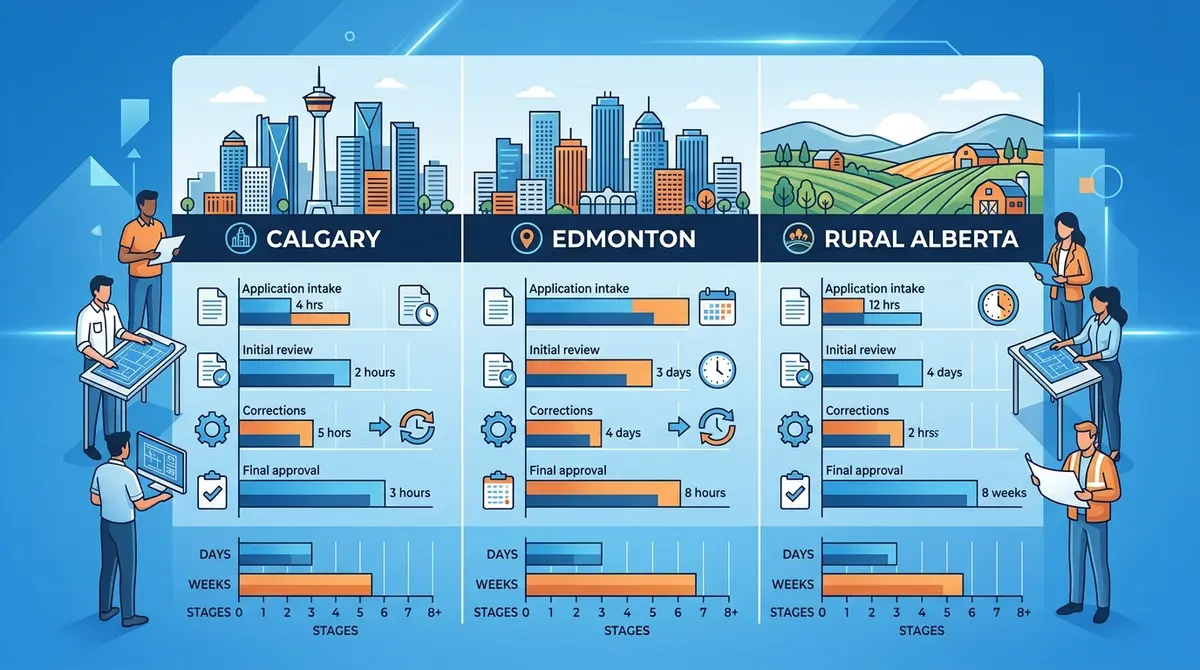
Location drastically impacts how long you will wait for authorization. Urban centers have more staff but higher volumes, while rural areas might have lower volumes but limited processing resources. This dynamic is a key consideration when weighing rural vs urban new home construction in Alberta.
| Municipality | Standard Build (Permitted) | Custom/Infill (Discretionary) | 2026 Expedited Options |
|---|---|---|---|
| Calgary | 3 – 4 Weeks | 8 – 12 Weeks | Yes (Certified Professionals Program) |
| Edmonton | 2 – 4 Weeks | 6 – 10 Weeks | Yes (Expedited Infill Program) |
| Red Deer | 3 – 5 Weeks | 6 – 8 Weeks | Limited |
| Rural Counties | 4 – 6 Weeks | 8 – 14 Weeks | No |
Note: Data reflects average processing times reported in Q1 2026. High construction seasons (Spring/Summer) may see extensions of 1 to 2 weeks.
Common Causes for Application Delays
Understanding why your build is stalled often comes down to administrative oversights during the application phase. In 2026, municipalities reported a 15% increase in total applications, putting immense pressure on civic planners.
As Sarah Jenkins, Senior Urban Planner at the Alberta Professional Planners Institute, explains: “Municipalities have digitized their portals to improve efficiency, but the onus remains on the applicant to provide flawless architectural controls. A digital system cannot fix an incomplete site plan.”
The most frequent bottlenecks include:
- Incomplete Documentation: Missing engineering stamps, incomplete energy modeling reports, or absent lot grading plans account for 65% of all initial rejections.
- Zoning Conflicts: Attempting to build a structure that exceeds the maximum allowable lot coverage or height restrictions without applying for a variance beforehand.
- Environmental Assessments: Builds located near escarpments, wetlands, or flood fringes require specialized geotechnical reports.
- Community Opposition: For discretionary uses, neighbors have the right to appeal the development to the Subdivision and Development Appeal Board (SDAB), which can stall a project by 30 to 60 days.
Strategies to Expedite Your Municipal Approvals
While you cannot control civic staffing levels, you can control the quality of your submission. Employing strategic approaches can significantly reduce your wait times.
First, utilize certified professionals. Both Calgary and Edmonton offer expedited streams for applications submitted by pre-vetted, registered architects and builders. Because these professionals have a proven track record of code compliance, their applications bypass the preliminary screening queues. For instance, Edmonton’s expedited program has been shown to cut processing times by up to 30%.
David Chen, a Chief Building Official, notes: “The transition to the updated National Building Code – Alberta Edition means examiners are scrutinizing energy efficiency metrics more closely than ever. Submitting pre-verified energy models is the fastest way to get your file moved to the top of the pile.”
Furthermore, ensure your financing is aligned with your timeline. Engaging with the new home construction loan process early ensures that once the city issues the authorization, your funds are ready for immediate disbursement, allowing you to break ground the next day.
The Financial Impact of Approval Timelines
Time is undeniably money in the construction sector. Delays in securing municipal authorizations do not just push back your move-in date; they actively erode your project’s profitability and budget.
Marcus Thorne, Director of Development at the Western Build Coalition, emphasizes this reality: “Time is money in real estate development. Every week lost in the queue translates directly to increased holding costs and potential interest rate exposure.”
Industry data from the Canadian Home Builders’ Association – Alberta reveals that holding costs—which include property taxes, insurance, and interest on land loans—average between $150 and $300 per day for a standard residential lot. A four-week delay in the planning department can easily add $4,200 to $8,400 in unrecoverable expenses.
Additionally, prolonged timelines expose builders to material price fluctuations. If your approval takes 12 weeks instead of 4, the cost of lumber, concrete, and steel may shift significantly. Investors must account for these variables; assuming a standard four-week turnaround for a non-conforming lot is a recipe for budget overruns, according to Real Estate Economist Elena Rostova.
Post-Approval: Inspections and Utilities
Securing the paperwork is only the beginning of your relationship with the municipality. Once construction commences, the city will mandate a series of site visits to ensure the build matches the approved plans. Familiarizing yourself with the new home construction inspections timeline is crucial, as failing a framing or electrical inspection will halt progress immediately.
Simultaneously, you must coordinate with local service providers. Connecting your new build to Alberta utilities (water, sewer, gas, and grid power) requires its own set of applications, which should be submitted the moment your primary building authorization is granted to avoid delays prior to possession.
Frequently Asked Questions
Can I start clearing my lot before the building permit is issued?
Generally, no. Most Alberta municipalities prohibit significant site grading, excavation, or tree removal until the Development Permit is officially issued. Doing so can result in stop-work orders and heavy fines.
How long is a building permit valid in Alberta?
In most jurisdictions, construction must commence within 90 to 120 days of the permit being issued. If work is abandoned or suspended for more than 120 days, the permit may expire, requiring a costly renewal process.
Do I need a separate permit for a secondary suite or basement development?
Yes. If you are building a home with a legal secondary suite, this must be explicitly stated in the initial application. Retroactively adding a suite requires a new development and building application. For more details, review options for basement development in Alberta.
What happens if my development application is refused?
If your application is denied, you have the right to appeal the decision to the local Subdivision and Development Appeal Board (SDAB) within 21 days. Alternatively, you can revise your architectural plans to comply with the planner’s feedback and resubmit.
Does the builder or the homeowner apply for the permits?
While a homeowner can legally apply, it is highly recommended that the general contractor or architect handles the submission. They possess the technical knowledge required to answer complex queries from safety codes officers.
How much do residential building permits cost in 2026?
Fees vary by municipality and are typically calculated based on the square footage or the estimated construction value of the project. On average, expect to pay between $2,500 and $5,000 for full municipal authorizations on a standard single-family home.
Conclusion
Navigating the municipal approval landscape in 2026 requires patience, precision, and a proactive approach. By understanding the distinction between development and building phases, anticipating common bottlenecks, and submitting comprehensive, code-compliant applications, you can significantly streamline your project’s timeline. Whether you are constructing a rural estate or an urban infill, minimizing your time in the administrative queue is the most effective way to control costs and keep your build on schedule.
If you are planning a new residential project and need expert guidance to navigate zoning laws, financing, and municipal approvals, our team is here to help. Contact us today to ensure your next build starts on a solid, fully approved foundation.


