



Conducting a geotechnical site assessment for new residential developments in Alberta involves extracting earth samples to determine the site’s load-bearing capacity, composition, and moisture levels before pouring a foundation. This mandatory engineering evaluation prevents catastrophic structural failures caused by Alberta’s notorious expansive clays and deep frost lines, ensuring the home meets the stringent 2026 provincial building codes.
Key Takeaways
- Geotechnical reports dictate the specific type of foundation required, ranging from standard spread footings to deep cast-in-place concrete piles.
- Expansive clay soils, highly prevalent in regions like Edmonton and Calgary, can exert up to 15,000 pounds of pressure per square foot on foundation walls.
- Professional site assessments typically cost between $1,500 and $3,500, a minor investment that prevents structural repairs averaging $45,000.
- The 2026 Alberta Building Code mandates site-specific ground analysis for multi-unit, complex residential builds, and properties in designated hazard zones.
- Frost susceptibility analysis is critical, as Alberta’s frost line can penetrate up to 2.5 meters deep during severe winters.
The Geological Reality of Alberta’s Landscape
Alberta’s unique topography is a product of ancient glacial activity, leaving behind a complex tapestry of subsurface conditions. The Western Canadian Sedimentary Basin provides a foundation of bedrock, but it is heavily overlaid with glacial till—a highly variable mixture of clay, silt, sand, and gravel. For developers and homebuyers, understanding what lies beneath the topsoil is not just a matter of curiosity; it is the fundamental basis of structural engineering.
According to research from the Canadian Home Builders’ Association, foundation issues account for nearly 40% of post-construction structural claims nationwide. In Alberta, this risk is amplified by the presence of highly plastic clays. These soils possess a high capacity to absorb water, leading to significant volume changes throughout the changing seasons. When wet, the ground swells; when dry, it shrinks, creating a cyclical movement that can easily fracture unreinforced concrete.
As Dr. Marcus Thorne, Lead Geotechnical Engineer at the Alberta Soil Sciences Institute, explains:
“Without a comprehensive geotechnical investigation, you are essentially designing a multi-million dollar structure blindfolded. In 2026, precision in bearing capacity calculations is the baseline for sustainable residential development.”
Why Pre-Construction Site Assessments are Non-Negotiable in 2026
Historically, some residential builders relied on regional assumptions rather than site-specific data. However, modern construction standards have evolved. Today, analyzing the ground conditions is a critical prerequisite for securing permits, finalizing architectural plans, and obtaining comprehensive warranty coverage. Without this data, engineers must use highly conservative estimates, which often leads to over-engineering the foundation and unnecessarily inflating construction budgets.
Furthermore, insurance providers have tightened their underwriting guidelines. To understand how these engineering reports impact your overall coverage, reviewing the insurance requirements for new builds is essential. Insurers want documented proof that the foundation design is explicitly tailored to the specific geological conditions of the lot.
The Hidden Dangers of Expansive Clay and Frost Heave
Two primary geological threats dominate the Alberta construction landscape: expansive soils and frost heave. Expansive clays contain minerals like smectite, which absorb water molecules into their crystalline structure. This swelling exerts massive hydrostatic pressure against basement walls, leading to bowing, cracking, and eventual water ingress.
Frost heave presents an equally destructive force. When water in the ground freezes, it expands by approximately 9%. If the earth beneath a foundation footing freezes, it can lift the entire structure. Because Alberta experiences prolonged sub-zero temperatures, the frost line can reach depths of 2.5 meters. Proper frost protection strategies rely entirely on accurate moisture and composition data gathered during the initial site investigation.
Step-by-Step: The Geotechnical Investigation Process
A proper ground analysis is a highly technical procedure executed by licensed geoscientists and engineers. The process is standardized by organizations such as the Association of Professional Engineers and Geoscientists of Alberta (APEGA) to ensure accuracy and public safety. Here is how the process unfolds:
- Desktop Study and Site Reconnaissance: Engineers review historical geological maps, previous borehole logs from the area, and topographical data to identify potential red flags before stepping foot on the property.
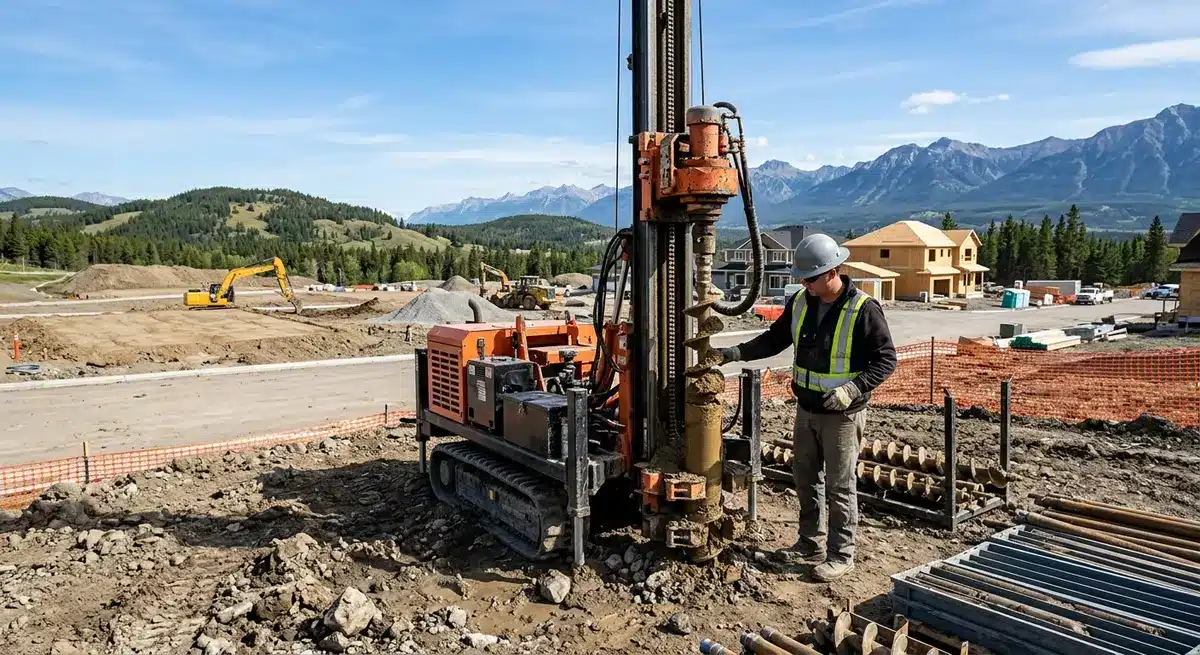
- Borehole Drilling and Sampling: Using specialized drilling rigs, technicians advance boreholes into the earth, typically to a depth of 6 to 8 meters for standard residential builds. They perform Standard Penetration Tests (SPT) to measure ground density and extract undisturbed core samples.
- Laboratory Analysis: The extracted samples are sent to a materials testing laboratory. Technicians determine the moisture content, grain size distribution, and Atterberg limits (which measure the plasticity index of the clay). They also test for water-soluble sulfates, which can chemically attack concrete.
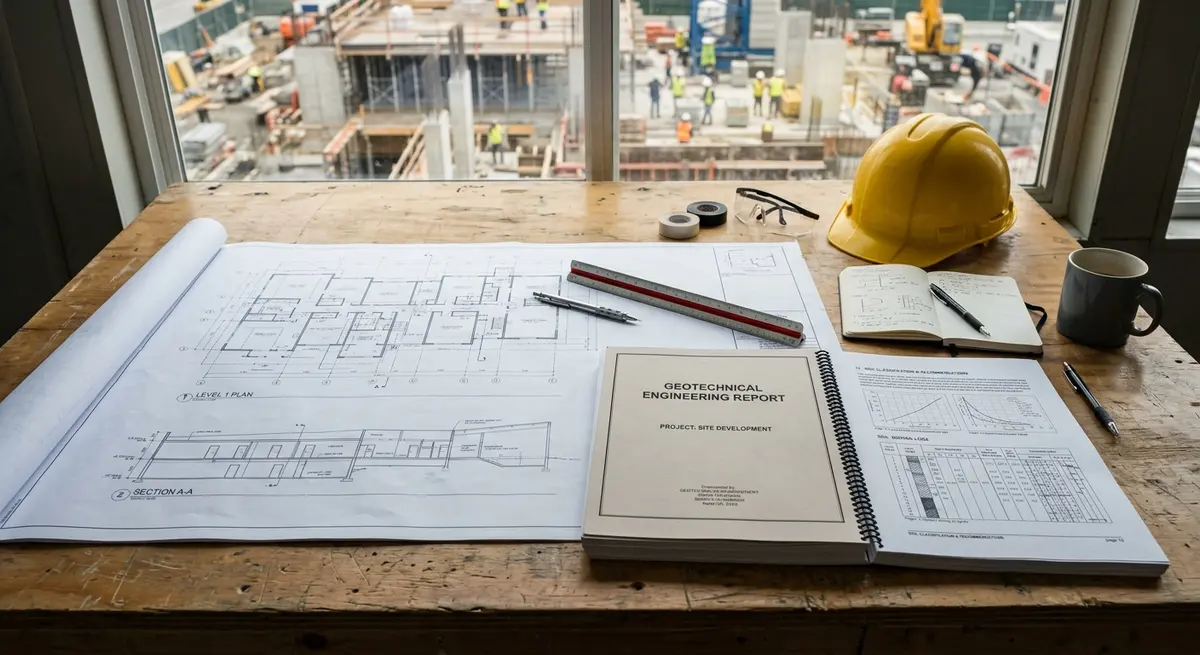
- Engineering Report Generation: A licensed professional engineer synthesizes the field and lab data into a comprehensive geotechnical report. This document provides explicit recommendations for foundation type, drainage requirements, and concrete specifications.

Interpreting the Geotechnical Report
For homebuyers and developers, the geotechnical report can read like a foreign language. However, understanding its core components is vital for managing construction timelines and budgets. The most critical metric is the “allowable bearing capacity,” expressed in kilopascals (kPa) or pounds per square foot (psf). This number dictates how much weight the ground can safely support without excessive settlement.
The report will also identify the groundwater table elevation. If the water table is high, the builder must implement aggressive waterproofing measures and specialized weeping tile systems. This directly impacts the feasibility and cost of subterranean living spaces, which is a crucial factor when planning your basement development strategy.
“The geotechnical report is the blueprint for the foundation,” notes Sarah Jenkins, a senior structural engineer based in Calgary. “If the report indicates high sulfate levels, we must specify Type HS (High Sulfate-resistant) cement. Ignoring that single detail can reduce a foundation’s lifespan from a century to less than a decade.”
Cost vs. Risk: Budgeting for Site Assessments
While some buyers view engineering tests as an annoying upfront expense, they are a vital risk mitigation tool. When calculating your closing costs and pre-construction budget, allocating funds for a proper site assessment is non-negotiable. Below is a comparison of typical testing scopes and their associated costs in 2026.
| Testing Scope | Typical Use Case | Estimated Cost (CAD) | Data Provided |
|---|---|---|---|
| Basic Assessment | Standard single-family homes in established urban subdivisions. | $1,500 – $2,200 | 1-2 boreholes, basic bearing capacity, visual classification. |
| Comprehensive Investigation | Custom acreage builds, multi-unit structures, or areas with known geological instability. | $2,800 – $4,500 | 3+ boreholes, full lab analysis (Atterberg limits, sulfates), slope stability analysis. |
| Environmental Phase I/II | Infill properties with potential historical contamination (e.g., former industrial sites). | $3,500 – $10,000+ | Hydrocarbon testing, heavy metal analysis, groundwater monitoring. |
How Ground Conditions Dictate Foundation Design
The ultimate goal of geotechnical investigations is to inform structural design. If the earth is stable, dense, and has a high bearing capacity, builders can utilize standard spread footings. These are wide concrete bases poured directly into shallow trenches, which distribute the home’s weight evenly.
However, if the report reveals deep layers of soft clay or uncompacted fill, shallow footings will fail. In these scenarios, engineers must bypass the weak upper layers and transfer the structural load to deeper, more competent strata. This is typically achieved using driven steel piles or cast-in-place concrete piles. While piling adds significant cost to the build, it guarantees long-term stability and prevents differential settlement, which causes doors to stick and drywall to crack.
Navigating Alberta Building Code Requirements
The regulatory landscape governing residential construction is continually evolving to enhance safety and energy efficiency. The Government of Alberta regularly updates the provincial building code to address emerging geological and climatic challenges. Under the 2026 code revisions, the requirements for site-specific engineering have become more stringent, particularly for multi-unit dwellings and homes built on steep grades.
Municipalities also enforce their own bylaws regarding lot grading and drainage, which are heavily influenced by subsurface conditions. Before purchasing land, it is highly recommended to review the zoning regulations and lot size requirements for your specific municipality, as these rules often dictate how much of the property can be covered by impermeable surfaces.
Urban Infill vs. Rural Acreage Considerations
The location of your build drastically alters the scope of the required ground analysis. When evaluating rural versus urban construction, the geological unknowns are vastly different. In established urban subdivisions, developers have often performed mass grading and preliminary testing for the entire neighborhood. While individual lot testing is still required, the general geological profile is usually well-understood.
Conversely, building on a rural acreage introduces a host of wildcards. Acreage properties may contain hidden peat bogs, high water tables, or undocumented fill from previous agricultural activities. Furthermore, rural properties require independent septic systems and water wells, both of which rely entirely on specific percolation rates and aquifer depths. If you are currently in the land acquisition phase, understanding how to choose the right lot involves making site assessments a condition of your purchase offer.
Frequently Asked Questions (FAQ)
Is a geotechnical report legally required to build a house in Alberta?
Yes, in most jurisdictions across Alberta, a geotechnical report is required to obtain a building permit, especially for custom homes, multi-unit structures, and properties located in new subdivisions or known hazard zones. The 2026 Alberta Building Code mandates that foundations be designed according to site-specific bearing capacities.
How long does the earth sampling and testing process take?
The entire process, from borehole drilling to the issuance of the final engineering report, typically takes between 2 to 4 weeks. Laboratory analysis of the core samples is the most time-consuming phase, often requiring 7 to 10 days to accurately measure moisture content and plasticity.
Can I use the developer’s subdivision report instead of testing my specific lot?
While a subdivision-wide report provides a helpful baseline, it is rarely sufficient for final structural design. Soil conditions can vary drastically within a few meters, meaning your specific lot could have a hidden pocket of soft clay or a high water table not captured in the broader neighborhood survey.
What happens if the ground analysis reveals poor conditions?
If poor conditions are discovered, your structural engineer will design a specialized foundation to mitigate the risk. This usually involves upgrading from standard footings to deep concrete piles, implementing rigid raft slabs, or performing extensive soil replacement and compaction before building.
Does winter weather affect the ability to drill boreholes?
Geotechnical drilling can be performed year-round in Alberta. However, severe winter conditions and deep frost penetration can slow down the drilling rigs and slightly increase the cost of the field investigation due to the extra time and equipment required to penetrate the frozen upper layers.
Will my new home warranty cover foundation cracks if I skip testing?
No. Alberta’s mandatory new home warranty programs require builders to adhere strictly to the provincial building code and engineering best practices. Failing to conduct proper site assessments voids warranty coverage for structural defects and differential settlement.
Conclusion
Building a home is one of the most significant financial investments you will ever make, and its longevity relies entirely on the ground beneath it. Conducting a thorough geotechnical site assessment is not merely a bureaucratic hurdle; it is a vital engineering safeguard against Alberta’s challenging geological conditions. By identifying expansive clays, high water tables, and frost susceptibility before construction begins, you empower your builder to design a foundation that will stand the test of time.
Whether you are developing a custom acreage, investing in a multi-unit property, or purchasing a home in a new subdivision, understanding your site’s unique profile is the first step toward a successful build. If you need guidance navigating the complexities of pre-construction planning, engineering requirements, or finding reputable builders in your area, contact us today to speak with our team of Alberta new home experts.


