



Understanding the true value of a property in 2026 requires looking beyond list prices and analyzing the hard data of recent transactions. The Alberta housing market is currently undergoing a significant recalibration, transitioning from the frantic bidding wars of previous years into a balanced, sustainable environment. Active listings across the province have increased by over 30% compared to early 2025, significantly improving buyer choice and negotiating power. For prospective buyers and investors, leveraging a comprehensive comparative market analysis is more essential than ever to ensure you are not overpaying in a landscape that now allows for careful deliberation and strategic acquisitions.
Key Takeaways: 2026 Alberta Housing Market
- Inventory Recovery: Active listings have surged by 30% year-over-year, shifting leverage back toward buyers in major metropolitan areas.
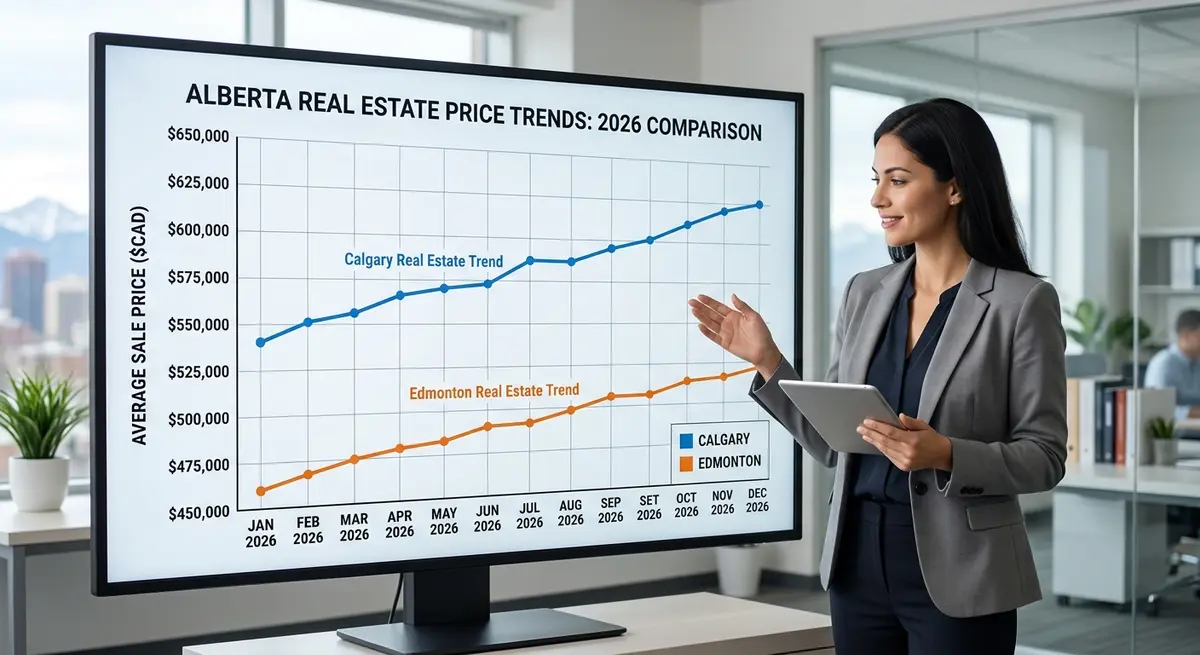
- Price Stabilization: Calgary detached home median prices have leveled at $706,000, while Edmonton continues a steady climb at $490,700.
- Multi-Family Demand: High-density housing, particularly apartment condominiums, is outperforming detached homes in percentage price growth.
- Extended Days on Market: The average time to sell has lengthened to 60-90 days, providing ample time for thorough inspections and financing approvals.
- New Build Saturation: A surge in quick-possession homes from builders is exerting downward pressure on the resale pricing of newer suburban properties.
The 2026 Alberta Real Estate Landscape: A Tale of Two Cities
When examining the latest Alberta Real Estate Market Analysis, the divergence between the province’s two major metropolitan areas is the most striking feature. The macroeconomic factors driving these cities have created two distinct investment environments.
Calgary has officially entered a cooling phase. The benchmark price for a detached home has seen a 3% decline from its 2025 peak, largely driven by a 21% year-over-year increase in active listings. The seller’s market conditions that defined the city for the last three years are transitioning into a state of equilibrium. According to recent data published by the Canadian Real Estate Association (CREA), this shift is not indicative of an economic downturn, but rather a return to historical norms following a period of unsustainable hyper-growth.
“The transition we are witnessing in Calgary during 2026 is not a market correction, but a necessary recalibration toward sustainable inventory levels,” says Dr. Elena Rostova, Senior Economist at the Canadian Real Estate Research Institute. “Buyers finally have the breathing room to conduct due diligence without the pressure of blind multiple-offer scenarios.”
In stark contrast, Edmonton is emerging as the province’s growth leader for 2026. While Calgary cools, Edmonton has seen single-family home prices increase by 4.8% year-over-year. The city remains the affordability champion of major Canadian hubs, attracting a steady stream of interprovincial migrants who are equity-rich but price-conscious. For investors, Edmonton Property Market Insights reveal aggressive growth potential and higher rental yields compared to its southern counterpart.
Analyzing the Data: Key Metrics for Property Valuation
Professional investors rely on specific technical metrics to spot opportunities before they become mainstream news. Two of the most critical indicators in 2026 are the “Months of Inventory” (MOI) and the “Sales-to-New-Listings Ratio” (SNLR).
The MOI metric measures how long it would take to sell all current listings if no new properties were added to the market. A balanced market typically hovers around four months. Currently, Calgary is seeing its MOI rise toward 2.7 months—a 29% increase from last year. Meanwhile, the SNLR in certain Edmonton sectors has hit 106%, signaling that demand is still heavily outpacing supply in the entry-level detached segment.
| Market Metric (Q1 2026) | Calgary | Edmonton |
|---|---|---|
| Median Detached Price | $706,000 | $490,700 |
| Year-Over-Year Growth | -3.0% (from peak) | +4.8% |
| Months of Inventory (MOI) | 2.7 Months | 1.9 Months |
| Average Days on Market | 65 Days | 42 Days |
New Construction vs. Resale: Where is the Value?
One of the most influential factors in the current market is the sheer volume of new construction. In late 2025, the province saw a record number of housing starts, according to Statistics Canada. Those units are now hitting the market as spec homes or ready-to-move properties. Builders are highly motivated to clear this inventory, often offering incentives like capped mortgage rates or included landscaping that a resale seller simply cannot match.
“Builders are highly motivated to clear spec inventory before the spring market, creating a rare window where new construction effectively competes with resale pricing,” explains Sarah Jenkins, Lead Developer Advocate at the Western Canada Builders Association.
When evaluating New Construction vs Resale Homes, buyers must weigh the premium of a brand-new property against long-term savings. A new build offers a clean slate with the latest energy efficiency standards and a 10-year structural warranty, significantly lowering long-term maintenance forecasts. However, buyers must account for the settling period of a new community, where schools and transit infrastructure might still be under development.

Strategic Shifts Toward High-Density and Multi-Family Investments
The 2026 market is defined by a significant push toward density. Apartment condominiums and townhouses are seeing a surge in demand as buyers look for ways to offset higher living costs. For real estate investors, navigating the Financing Options for Alberta Homes has never been more critical, particularly with the introduction of aggressive federal lending incentives.
The Canada Mortgage and Housing Corporation (CMHC) currently offers specialized multi-family financing programs that allow for up to 50-year amortization periods if a building meets specific criteria for affordability, accessibility, or energy efficiency. This extended amortization can turn a marginally profitable building into a cash-flow powerhouse by dramatically reducing monthly debt obligations.
“Securing extended amortization through federal energy-efficiency programs has fundamentally altered the cash-flow equation for multi-family investors in Alberta,” states David O’Connor, Principal at Prairie Investment Partners. “Because Alberta lacks provincial rent control, meeting the federal affordability criteria is often easier to achieve here than in coastal markets, allowing investors to access 95% loan-to-value financing with minimal sacrifice to their gross operating income.”
Pre-Construction vs. Existing Homes: A Risk-Reward Analysis
When reviewing a comparative market analysis, you will often notice a price gap between existing homes and those sold on paper. Pre-construction is essentially a play on future appreciation. You secure a home at 2026 prices with the hope that by the time it completes in 2027 or 2028, the market will have moved higher. The primary advantage is capital liquidity; you only need a staggered deposit rather than a full mortgage immediately.
The counter-argument is the lack of immediate cash flow. A resale property can be tenanted within 30 days of closing, providing instant return on investment. Furthermore, resale homes allow you to physically inspect the space and assess the neighborhood’s established character. In a market that is stabilizing, the appreciation play of pre-construction carries slightly more risk than it did during the boom of 2023. A balanced portfolio approach is recommended: utilize resale properties for immediate income and pre-construction as a growth engine for long-term holdings.
How to Leverage Market Data for Your Next Purchase
Understanding the Alberta Real Estate Market is only the first step; applying that data to your purchasing strategy is where true value is created. Follow these steps to utilize market reports effectively:
- Define Your Micro-Market: Broad city data is useful for trends, but real estate is hyper-local. Narrow your focus to specific neighborhoods or even specific property types (e.g., 10-year-old detached homes with legal basement suites).
- Analyze Sold Comparables: Ignore asking prices. Focus exclusively on properties that have successfully closed within the last 60 to 90 days. Adjust the baseline value for differences in square footage, lot size, and premium upgrades.
- Assess the SNLR: Check the Sales-to-New-Listings Ratio for your target neighborhood. If it is below 40%, you are in a strong buyer’s market and should negotiate aggressively on price and terms.
- Evaluate Builder Incentives: If looking at new builds, quantify the exact monetary value of builder promotions (like free basement developments or appliance packages) and deduct this from the purchase price to find the effective cost.
- Formulate a Data-Backed Offer: When submitting an offer, have your representative include a summary of the comparative data to justify your price, removing emotion from the negotiation process.

Protecting Your Interests with Independent Representation
A significant risk in today’s market is the temptation to deal directly with a builder’s sales center or a listing agent without independent representation. These sales representatives are highly trained professionals legally obligated to protect the seller’s or builder’s interests—not yours. They will rarely volunteer comparative data that includes lower-priced resale options or competing builders’ incentives.
Navigating Alberta Property Transactions requires an advocate who can negotiate price reductions, scrutinize contract clauses, and ensure warranty inclusions are properly documented. Utilizing a dedicated buyer’s agent costs you nothing out of pocket, as their fees are traditionally covered by the seller, yet they provide an invaluable layer of protection against one-sided contracts and overvalued upgrades.
Frequently Asked Questions
What exactly is a comparative market analysis in real estate?
A comparative market analysis is a data-driven document that evaluates a specific property against similar homes that have recently sold in the same immediate area. It relies on actual sold prices rather than asking prices, making adjustments for variables like square footage, age, and lot size. This is the most accurate method for determining a property’s fair market value in real-time.
Why are Calgary house prices stabilizing in 2026?
Stabilization in Calgary is primarily driven by a 21% increase in active listings and a moderation in net interprovincial migration. With more inventory available, buyers have more room to negotiate and include conditions in their offers. This increased supply has successfully halted the rapid, unsustainable price spikes witnessed in previous years.
How does the “months of inventory” metric affect my buying power?
The months of inventory metric measures how long it would take to deplete all current property listings if no new homes were added to the market. A balanced market is typically around four months. With Alberta currently sitting between 1.9 and 2.7 months depending on the city, the market still leans slightly toward sellers, but is rapidly moving toward a buyer-friendly equilibrium.
Is it better to buy in Edmonton or Calgary for rental income?
Edmonton currently offers a lower barrier to entry and higher capitalization rates for real estate investors. While Calgary commands higher monthly rents, the initial acquisition costs are significantly steeper. Current market data shows that Edmonton properties generally achieve positive cash flow more easily with a standard 20% down payment.
Can I use market data to appeal my property tax assessment?
Yes, property tax assessments can be formally appealed using recent market data. If your municipal assessment is significantly higher than what comparative reports show for similar properties sold near the valuation date, you can submit this data to the assessment review board as evidence for a reduction.
Do home builders allow buyer’s agents in their sales centers?
Reputable home builders actively encourage professional representation and cooperate with buyer’s agents. However, it is crucial that your agent accompanies you during your very first visit to the sales center to be properly registered. Having an agent ensures a professional review of building specifications and a fair comparison against the broader market.
What is the most important feature for resale value in 2026?
Energy efficiency and secondary suite potential are the top drivers of resale value in the current market. Homes equipped with high-efficiency HVAC systems, solar integrations, or legally zoned basement suites are fetching significant premiums. Data consistently shows that properties with these features sell faster and closer to their asking price.
How accurate are online instant home value estimates?
Online valuation tools rely on broad algorithms and cannot account for a home’s specific condition, recent interior renovations, or hyper-local neighborhood shifts. A professional market analysis is vastly more reliable because it involves human verification of specific comparables and adjustments for current micro-economic conditions.
Conclusion
The 2026 comparative data for Alberta houses indicates a province that has successfully transitioned from a state of frenzy to a state of strategic focus. While the effortless equity gains of the early 2020s have normalized, the current market offers something far more valuable for the serious buyer and investor: predictability, choice, and the time to conduct proper due diligence. Whether you are looking to capitalize on Edmonton’s growth trajectory, secure a stabilized asset in Calgary, or leverage federal financing for multi-family developments, success depends on accurate data and professional guidance. By understanding the Steps to Purchasing a Home in Alberta and utilizing independent representation, you can navigate these price shifts with absolute confidence. Ready to explore your options in the 2026 market? Contact our team today to build your personalized real estate strategy.


