



Photovoltaic panels directly contribute to qualifying for federal multi-unit green financing points by measurably reducing a building’s overall energy consumption and greenhouse gas emissions. By generating clean, on-site electricity, solar installations help property owners achieve the required 20% to 40% energy efficiency improvements, unlocking premium mortgage benefits such as 95% loan-to-value ratios, 50-year amortizations, and significantly reduced insurance premiums in 2026.
Key Takeaways
- Solar arrays are the most mathematically predictable method for achieving top-tier federal sustainability scores in 2026.
- Properly documented photovoltaic systems can reduce multi-unit mortgage insurance premiums to as low as 1.00%.
- Alberta’s high solar irradiation levels make it the premier Canadian market for energy-efficient real estate investments.
- All solar equipment must hold CSA or UL certifications to qualify for federal underwriting points.
- Combining solar generation with high-performance HVAC systems maximizes your overall property scoring and long-term valuation.
The 2026 Landscape of Green Mortgage Financing in Alberta
Alberta’s real estate market continues to evolve with innovative financing solutions that recognize the growing importance of sustainable housing features. The federal government’s premier sustainability scoring system represents a paradigm shift in how lenders evaluate property value and risk. Unlike traditional mortgage programs that focus primarily on location, square footage, and basic structural elements, this modern framework incorporates a comprehensive scoring system that rewards energy-efficient features, sustainable building practices, and long-term environmental benefits.
This approach recognizes that homes with superior energy performance represent lower financial risk and higher long-term value retention. As utility costs fluctuate, properties that generate their own power offer highly predictable operating expenses. For developers and investors exploring financing options for Alberta homes, understanding this point-based underwriting system is no longer optional—it is a critical component of maximizing return on investment.
As Marcus Thorne, Senior Underwriter at Prairie Green Financial, explains: “The 2026 federal mortgage framework fundamentally changes how we value assets. A building generating its own power represents substantially lower default risk, which is why the point system heavily rewards photovoltaic integration. We are seeing investors increase their purchasing power by millions simply by adding commercial-grade solar arrays.”
How Photovoltaic Systems Earn Sustainability Points
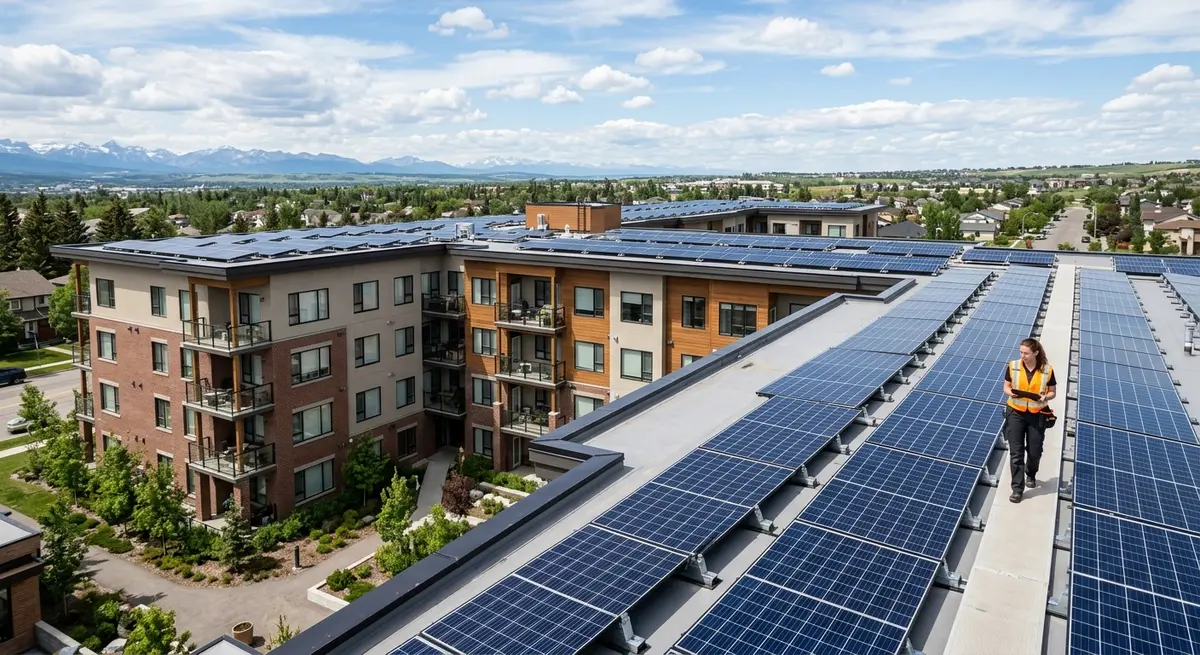
Photovoltaic panels, commonly known as solar panels, occupy a particularly important position within the federal green scoring framework due to their measurable impact on a property’s energy profile. The program evaluates solar installations based on multiple criteria, including system capacity measured in kilowatts, expected annual energy production, integration with the home’s electrical systems, and projected performance over the system’s operational lifetime.
To earn points, a building must demonstrate a reduction in energy consumption or greenhouse gas emissions relative to the National Energy Code of Canada for Buildings (NECB) 2020 standards. According to data from Natural Resources Canada, a standard 50kW rooftop array in Calgary can offset up to 65,000 kWh annually. This massive offset often pushes a mid-sized multi-unit building past the 40% reduction threshold required for maximum financing points.
The scoring methodology considers both the immediate energy production capabilities and the long-term financial benefits that solar installations provide. Properties with properly sized systems demonstrate significant reductions in ongoing electricity costs, directly improving the debt-coverage ratio (DCR). This improved affordability profile makes these properties highly attractive to lenders evaluating understanding property investments in the current economic climate.
Technical Requirements for Solar Panel Qualification
Achieving federal mortgage qualification through photovoltaic panel installations requires meeting specific technical standards that ensure system quality, performance, and long-term reliability. The program establishes minimum capacity thresholds that solar installations must exceed to contribute meaningfully to the property’s overall score. These thresholds ensure that solar systems provide substantial energy production relative to the building’s consumption patterns.
Equipment certification represents another critical requirement. Photovoltaic panels, inverters, mounting systems, and other components must carry appropriate certifications from recognized testing organizations such as the Canadian Standards Association (CSA) or Underwriters Laboratories (UL). These certifications verify that equipment meets stringent safety, performance, and durability standards essential for long-term system reliability.
Furthermore, professional installation by qualified technicians is mandatory. The program requires that solar installations be completed by certified professionals who possess appropriate licensing and training in solar system design, installation, and commissioning. Factoring these requirements into your construction materials cost forecast early in the development phase prevents unexpected budget overruns.
Step-by-Step Guide to Documenting Solar Installations for CMHC Approval
To ensure your photovoltaic system successfully translates into mortgage points, follow this standardized documentation process:
- Engage a Certified Energy Advisor: Before construction or retrofitting begins, hire an advisor registered with Natural Resources Canada to establish your baseline energy model.
- Complete Pre-Construction Energy Modeling: Have your advisor simulate the building’s performance with and without the proposed solar array to quantify the exact percentage of energy reduction.
- Source Certified Equipment: Ensure all procured panels and inverters have documented CSA or UL certifications. Keep all specification sheets on file.
- Execute Professional Installation: Hire a licensed solar contractor to install the system, ensuring all local building codes and utility hookup processes are strictly followed.
- Submit Final As-Built Reports: After commissioning, the Energy Advisor must verify the installation and generate an “As-Built” energy report. This document is submitted directly to the federal housing agency to claim your points.

Financial Advantages of Energy-Efficient Mortgage Insurance
The financial advantages available through green mortgage qualification can be substantial for developers and investors. Enhanced loan-to-value (LTV) ratios represent one of the most significant benefits, allowing qualified borrowers to finance up to 95% of the property value while still accessing competitive mortgage terms. This increased financing capacity drastically reduces the initial capital requirements for solar-equipped multi-unit buildings.
Reduced mortgage insurance premiums provide another massive financial lever. The federal framework recognizes that buildings with superior energy efficiency characteristics represent lower risk profiles. This reduced risk translates into lower insurance costs, which can save property owners hundreds of thousands of dollars over the life of a commercial mortgage.
Additionally, achieving top-tier points unlocks the ability to stretch amortization periods up to 50 years. This dramatically lowers monthly debt servicing costs, instantly boosting cash flow. When combined with provincial tax credits for buyers, the return on investment for solar infrastructure becomes undeniable.
Comparison: Conventional vs. Green Tier Financing
| Financing Metric | Conventional Multi-Unit Mortgage | Green Tier 1 (20% Energy Reduction) | Green Tier 3 (40% Energy Reduction) |
|---|---|---|---|
| Maximum Loan-to-Value (LTV) | 85% | 95% | 95% |
| Maximum Amortization | 40 Years | 50 Years | 50 Years |
| Mortgage Insurance Premium | Standard Rates (up to 4.50%) | 1.70% | 1.00% |
| Debt Coverage Ratio (DCR) | 1.20 | 1.15 | 1.10 |
Alberta’s Unique Solar Advantage for Real Estate Investors
Alberta’s exceptional solar resource makes photovoltaic installations particularly effective for both energy production and mortgage qualification purposes. The province receives abundant sunshine throughout the year, with southern regions experiencing solar irradiation levels comparable to much more southern latitudes like Florida or Texas. This excellent solar resource ensures that properly designed photovoltaic systems generate substantial electricity.
According to the Canadian Renewable Energy Association, Alberta accounted for 92% of Canada’s overall growth in renewable energy capacity in recent years. This boom has created a highly mature local supply chain, driving down installation costs and increasing the availability of skilled technicians.
“Investors in Southern Alberta have a distinct geographic advantage,” notes Sarah Jenkins, Director of Operations at Alberta Solar Grid Solutions. “The solar irradiation levels in cities like Lethbridge and Medicine Hat mean that a system costs roughly 15% less to achieve the same energy offset points compared to a similar installation in British Columbia or Ontario.”
When analyzing the Alberta real estate market, regional variations must be considered. While Southern Alberta provides the highest yields, northern regions like Edmonton and Fort McMurray still provide sufficient solar resources to effectively contribute to green financing points, provided the arrays are sized correctly to account for winter sun angles.
Integrating Solar with Other Building Efficiencies
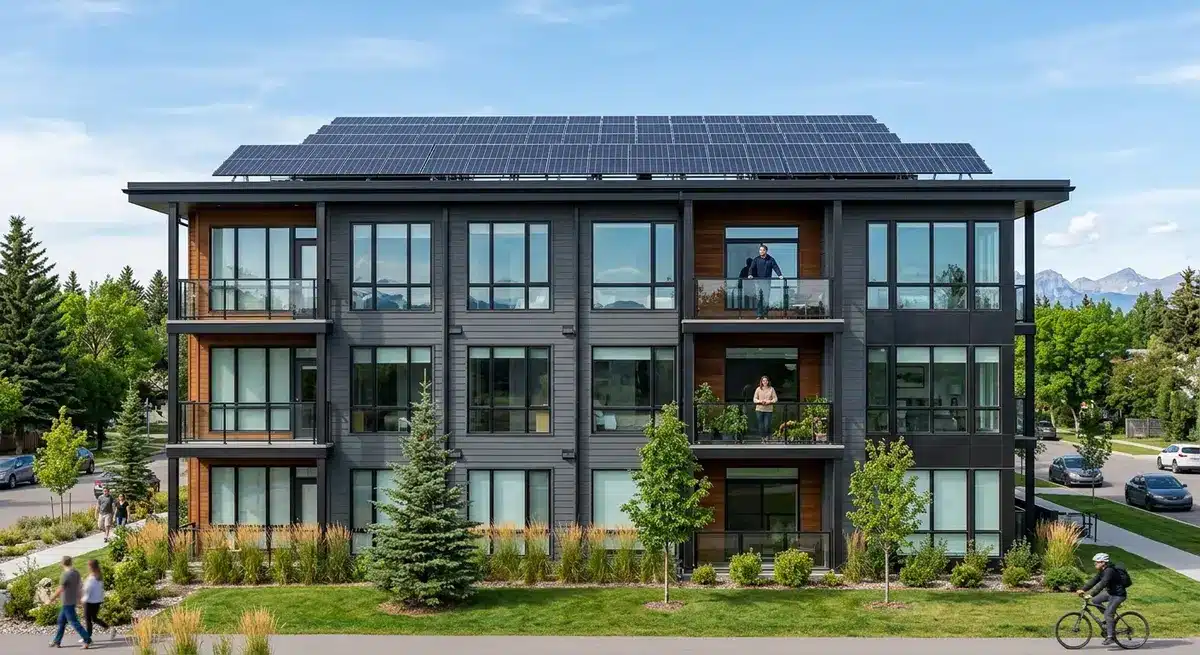
While photovoltaic panels are powerful tools for earning sustainability points, they work best when integrated into a holistic energy strategy. Slapping a massive solar array onto a building with a poor thermal envelope is an inefficient way to reach the 40% reduction target. Instead, developers should focus on synergistic technologies.
High-performance insulation, triple-pane argon-filled windows, and efficient HVAC systems (such as cold-climate air source heat pumps) drastically lower the building’s baseline energy demand. Once the demand is minimized, a smaller, more cost-effective photovoltaic array can easily offset the remaining consumption to hit top-tier scoring metrics.
Furthermore, integrating smart home technologies and automated building management systems ensures that the energy generated by the solar panels is used efficiently. It is also vital to secure proper new home construction insurance that specifically covers high-value green energy assets during the build phase, as solar panels are susceptible to damage before final commissioning.
Expert Insights on Maximizing Your Property’s Energy Score
The intersection of solar technology and mortgage financing creates compelling opportunities for Alberta developers. However, navigating the federal scoring system requires precision. The most common mistake developers make is treating the solar installation as an afterthought rather than integrating it into the initial architectural design.
Roof orientation, shading from future adjacent developments, and structural load-bearing capacities must be calculated during the drafting phase. Dr. Elena Rostova, Lead Energy Modeler at the Alberta Sustainable Building Institute, emphasizes this point: “Integrating high-capacity photovoltaic arrays is no longer just an environmental choice; it is the most mathematically reliable method to achieve the 40% energy consumption reduction required for top-tier federal mortgage incentives in 2026. Retrofitting is always more expensive than designing for solar from day one.”
Ultimately, solar-equipped buildings qualifying for green mortgage benefits demonstrate superior value retention and market appeal. They combine immediate financing advantages with ongoing operational cost savings, making them highly resilient assets in any economic environment.
Frequently Asked Questions (FAQ)
How much energy reduction is required for top-tier mortgage points?
To achieve the maximum points for energy efficiency under the federal green mortgage framework, a property must demonstrate a 40% reduction in energy consumption or greenhouse gas emissions compared to the NECB 2020 baseline.
Can existing buildings add solar panels to qualify for refinancing benefits?
Yes, existing multi-unit properties can qualify for green refinancing benefits. The building must undergo an energy audit, and the new solar installation must help achieve a minimum 20% to 40% reduction in energy consumption compared to its historical baseline.
Do solar panels increase property taxes in Alberta?
Generally, adding solar panels does not significantly increase your property tax burden in Alberta. Many municipalities actively encourage renewable energy and offer specific exemptions or clean energy improvement programs (CEIP) that prevent tax penalties for green upgrades.
What certifications do my solar panels need to qualify for federal points?
All photovoltaic equipment, including panels and inverters, must carry recognized safety and performance certifications. The most commonly accepted standards are from the Canadian Standards Association (CSA) or Underwriters Laboratories (UL).
How long does the energy modeling process take?
The pre-construction energy modeling process typically takes between 3 to 6 weeks, depending on the complexity of the building. It is highly recommended to engage a Certified Energy Advisor during the initial architectural drafting phase to avoid delays.
Can I combine solar panels with other energy upgrades to reach the 40% target?
Absolutely. In fact, combining a photovoltaic array with a high-efficiency building envelope, upgraded insulation, and commercial heat pumps is the most cost-effective and reliable strategy to achieve the maximum 40% energy reduction.
Conclusion
Navigating the 2026 real estate landscape requires a deep understanding of how sustainable technologies directly impact financing. Photovoltaic panels have proven to be one of the most effective, measurable, and reliable methods for Alberta property owners to qualify for federal green mortgage points. By offsetting grid consumption with clean solar energy, developers can unlock 95% loan-to-value ratios, secure 50-year amortizations, and drastically reduce their mortgage insurance premiums. When combined with Alberta’s world-class solar irradiation levels, the financial case for integrating solar into your next multi-unit project is stronger than ever.
If you are planning a new development or looking to refinance an existing property using green energy incentives, expert guidance is essential to ensure your energy modeling meets strict federal standards. Contact us today to connect with our team of real estate financing specialists and start maximizing your property’s potential.