



The maximum amortization period for Canada’s premier point-based multi-unit residential financing program extends up to 50 years for qualifying purpose-built rentals, while standard investment properties typically access 30-year terms. These extended repayment schedules dramatically lower monthly debt obligations, allowing Alberta real estate investors to improve Debt Service Coverage Ratios (DSCR), increase loan-to-value (LTV) limits, and scale their portfolios faster in a competitive 2026 market.
Key Takeaways
- Unprecedented Terms: Qualifying multi-unit residential properties can access repayment terms extending up to a half-century, significantly outpacing conventional commercial mortgages.
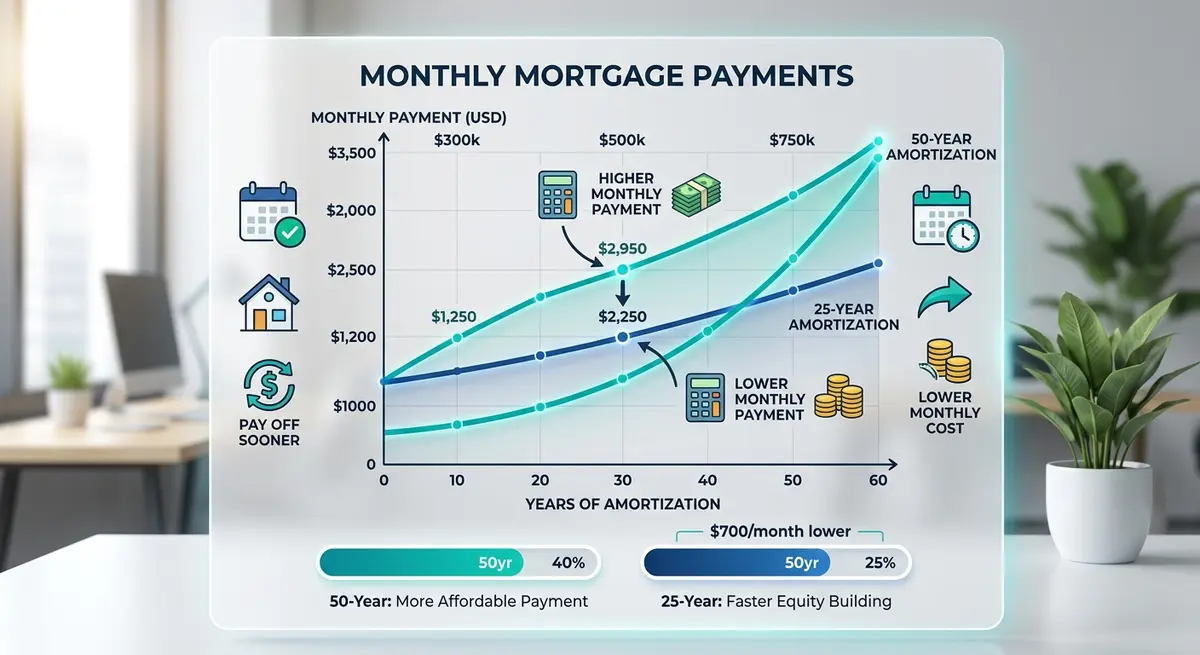
- Cash Flow Optimization: Extending an amortization schedule from 25 to 50 years can reduce monthly principal and interest payments by up to 22%, dramatically improving operational cash flow.
- Qualification Criteria: Accessing the absolute maximum terms requires meeting specific point-based thresholds related to housing affordability, energy efficiency, and accessibility.
- Enhanced Borrowing Power: Lower monthly payments improve DSCR calculations, often allowing investors to qualify for up to 95% LTV on multi-residential assets.
- Alberta Market Advantage: High interprovincial migration to cities like Calgary and Edmonton makes extended amortization a critical tool for developers building purpose-built rentals in 2026.
The Strategic Advantage of Extended Amortization in 2026
In the evolving landscape of Canadian real estate, the timeframe over which a mortgage is repaid—known as the amortization period—serves as the foundational mathematics of investment viability. While conventional investment property loans typically cap at 25 years, specialized federal mortgage insurance frameworks now offer maximum amortization periods that fundamentally alter the profitability of multi-residential assets.
According to the Canada Mortgage and Housing Corporation (CMHC), extending a repayment schedule from a standard 25-year term to a 40 or 50-year term can reduce monthly debt servicing costs by approximately 18% to 22%, depending on prevailing interest rates. This reduction is not merely a convenience; it is a strategic lever that transforms marginal projects into highly lucrative investments.
As Sarah Jenkins, Senior Commercial Underwriter at First National, explains: “In the 2026 lending environment, pushing your amortization from 25 to 50 years is the single most effective lever an investor has to turn a marginal multi-family project into a high-yielding asset. It provides the breathing room necessary to weather economic fluctuations while maintaining positive cash flow.”
For investors analyzing Alberta real estate market analysis data, these extended terms provide a distinct competitive edge. By lowering the monthly carrying costs, property owners can maintain competitive rental rates, absorb unexpected maintenance expenses, and reinvest surplus capital into further portfolio expansion.
How Property Types Dictate Your Maximum Repayment Term
Not all real estate investments are treated equally under federal financing guidelines. The maximum amortization period an investor can secure is heavily dependent on the specific classification and intended use of the property.
Standard Investment Properties
For traditional single-family rentals, duplexes, and small multi-family properties (typically under five units) that do not qualify for specialized commercial insurance, the maximum amortization period generally caps at 30 years. While this still offers a five-year advantage over conventional 25-year terms, it requires strong borrower financials and a minimum 20% down payment.
Purpose-Built Multi-Residential Assets
The true power of extended amortization is unlocked in the multi-residential sector (five or more units). Through specialized federal point-based initiatives designed to stimulate housing supply, developers and investors can access 40-year and even 50-year maximum amortization periods. This is particularly relevant for those exploring investment opportunities in Alberta real estate, where demand for high-density housing continues to surge.
Qualification Requirements for 40 and 50-Year Terms
Securing a half-century repayment schedule requires navigating a sophisticated underwriting process. Canada’s specialized mortgage insurance framework utilizes a point-based system where borrowers must accumulate a minimum of 100 points across three core social outcome categories to unlock the maximum amortization period.
- Affordability Commitments: Investors can earn points by dedicating a percentage of the building’s units to affordable housing. The rents for these units must typically be maintained at or below 30% of the median renter income for the specific market for a minimum of 10 years.
- Energy Efficiency Standards: Significant points are awarded for constructing or retrofitting buildings to exceed the 2020 National Energy Code of Canada for Buildings (NECB). Achieving a 40% reduction in greenhouse gas emissions and energy consumption is often required to maximize points in this category.
- Accessibility Integration: Incorporating universal design principles yields additional points. This involves exceeding local building codes to ensure units are fully accessible. Investors often consult new home accessibility features guides to ensure compliance with stringent federal standards.
Research from the University of Calgary’s Haskayne School of Business indicates that while meeting these criteria increases upfront capital expenditures by an average of 4% to 7%, the long-term financial benefits of a 50-year amortization schedule far outweigh the initial costs.
Financial Impact: Cash Flow and DSCR Analysis
The financial implications of securing maximum amortization periods extend deep into the mathematical core of real estate underwriting. The two most critical metrics impacted are the Debt Service Coverage Ratio (DSCR) and the Loan-to-Value (LTV) ratio.
Lenders use the DSCR to determine a property’s ability to cover its debt obligations. A DSCR of 1.0 means the Net Operating Income (NOI) exactly covers the mortgage payment. Specialized federal programs often allow for a minimum DSCR of 1.10 for residential spaces, compared to the conventional requirement of 1.25 or 1.30.
| Amortization Period | Monthly Payment ($5M Loan at 4.5%) | Required NOI (at 1.10 DSCR) | Principal Paid (Year 1) |
|---|---|---|---|
| 25 Years (Conventional) | $27,791 | $366,841 annually | $111,450 |
| 40 Years (Specialized) | $22,485 | $296,802 annually | $46,800 |
| 50 Years (Maximum) | $20,683 | $273,015 annually | $24,500 |
As demonstrated in the table above, extending the amortization to 50 years drops the required annual NOI by nearly $93,000 to qualify for the same $5 million loan. This mathematical reality allows investors to borrow significantly more capital against the same asset, frequently achieving up to 95% LTV.

Step-by-Step Guide to Securing Maximum Amortization
Navigating the complex landscape of specialized commercial financing requires a methodical approach. Investors must align their property acquisitions with federal objectives long before submitting a loan application.
- Initial Feasibility Analysis: Begin by assessing the property’s potential to meet the 100-point threshold. Review financing options for Alberta homes to understand the baseline requirements for commercial underwriting.
- Engage Specialized Consultants: Hire certified energy modelers and accessibility consultants early in the design or due diligence phase. Their reports are mandatory for proving compliance with federal point systems.
- Financial Underwriting: Work with a commercial mortgage broker who specializes in federal insured financing. They will model various amortization scenarios to find the optimal balance between cash flow and principal paydown.
- Submit for Insurance Approval: The lender submits the comprehensive package to the federal housing agency for review. This process can take 4 to 8 weeks, depending on application volumes.
- Finalize Lender Commitment: Once the insurance certificate is issued, the lender will finalize the mortgage commitment, locking in the maximum amortization period and interest rate.
Marcus Thorne, a Calgary-based multi-family developer, notes: “The upfront costs of energy modeling and accessibility consulting are negligible when you calculate the lifetime cash flow benefits of a half-century repayment schedule. It is an investment in your asset’s financial foundation.”
Navigating Alberta’s Specific Market Conditions
The application of these financing strategies varies significantly across different regions. Data published by Statistics Canada in early 2026 shows that Alberta’s population growth continues to outpace the national average, creating intense demand for rental housing.
When reviewing Edmonton property market insights, investors often find that lower acquisition costs combined with a 50-year amortization create unprecedented cash-on-cash returns. Conversely, in Calgary’s higher-priced market, the extended amortization is often the determining factor that allows a project to meet minimum DSCR requirements.
Comparing Specialized Insured Financing with Conventional Mortgages
Understanding how maximum amortization periods compare with alternative financing options is crucial for developing a robust portfolio strategy. While the benefits of extended terms are clear, they must be weighed against the flexibility of conventional lending.
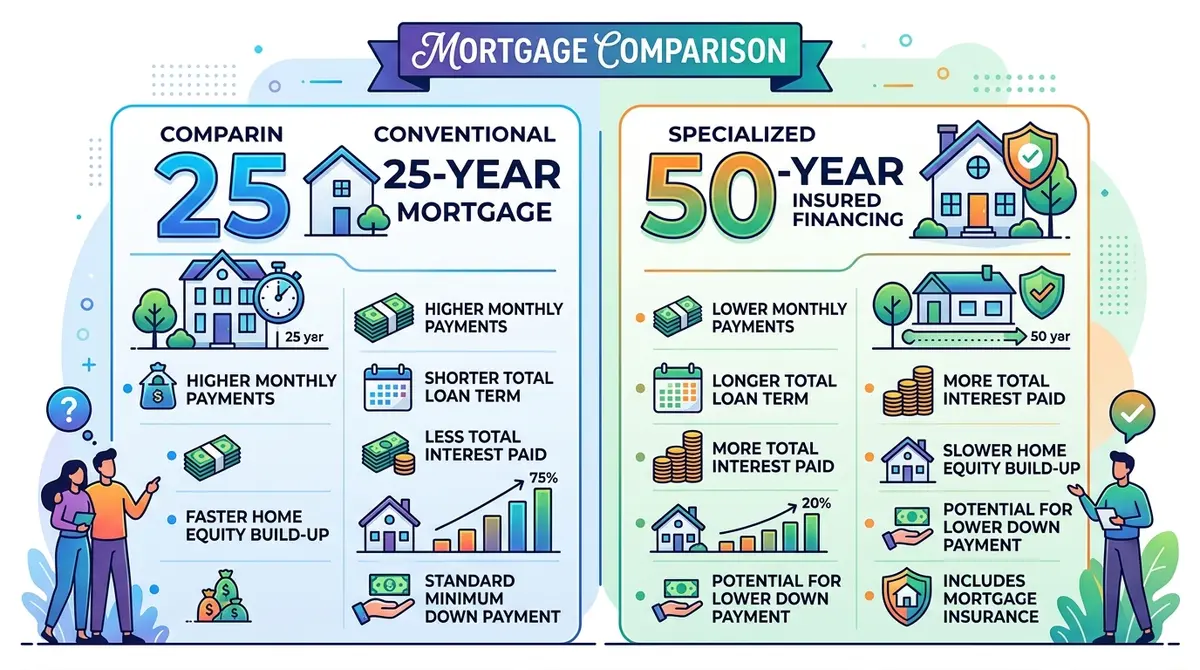
Conventional commercial mortgages typically offer faster approval times, fewer restrictions on tenant demographics, and no requirements for affordable housing commitments. However, they generally cap amortization at 25 years, require a minimum 25% to 35% down payment, and demand higher DSCR ratios.
In contrast, specialized insured financing offers up to 50-year amortizations, lower interest rates (due to the federal guarantee), and up to 95% LTV. The trade-off involves strict adherence to the point-based qualification system, higher upfront insurance premiums, and rigorous annual reporting requirements to prove ongoing compliance with affordability or energy commitments.
According to the Bank of Canada, as interest rates stabilize in 2026, the spread between conventional commercial rates and insured multi-residential rates remains significant, further incentivizing investors to pursue the specialized insured route.
Long-Term Wealth Strategies for Alberta Investors
Maximizing the benefits of extended amortization periods requires sophisticated investment planning. Successful real estate investors develop comprehensive strategies that leverage these terms to achieve specific financial goals while managing associated risks.
One primary consideration is the pace of equity accumulation. While a 50-year amortization drastically improves monthly cash flow, it significantly slows down principal paydown in the early years of the mortgage. Investors must balance their need for immediate liquidity against their long-term equity building objectives.
Dr. Elena Rostova, Real Estate Economist, states: “Alberta’s unique combination of high interprovincial migration and specialized federal financing options creates a generational wealth-building window for strategic investors. The key is reinvesting the cash flow generated by extended amortizations into further asset acquisition.”
Many savvy investors use the surplus cash flow generated by a 50-year amortization to aggressively fund the down payments for subsequent property acquisitions. By reviewing a comparative market report for Alberta houses, investors can identify emerging neighborhoods where this reinvestment strategy will yield the highest appreciation.
Furthermore, understanding the new home construction loan process is vital for developers looking to build purpose-built rentals from the ground up, ensuring that construction financing seamlessly transitions into a maximized 50-year term upon project completion.
Frequently Asked Questions
What is the absolute maximum amortization period available for commercial real estate in Canada?
As of 2026, the absolute maximum amortization period available is 50 years. This is exclusively accessible through specialized federal mortgage insurance programs for purpose-built multi-residential properties that meet strict point-based criteria for affordability, energy efficiency, and accessibility.
Does extending the amortization period increase my total interest costs?
Yes. While extending the amortization from 25 to 50 years significantly lowers your monthly payment, it substantially increases the total amount of interest paid over the life of the loan. Investors must weigh the benefits of increased monthly cash flow against the higher lifetime borrowing costs.
Can I get a 40-year amortization on a single-family rental property?
Generally, no. Standard single-family investment properties (1-4 units) typically max out at a 30-year amortization period. The 40 and 50-year terms are reserved for commercial multi-residential properties containing five or more units that participate in specialized federal housing initiatives.
How does a 50-year amortization affect my property’s resale value?
A 50-year amortization itself does not directly change the intrinsic value of the real estate. However, if the mortgage is assumable, offering a buyer the chance to take over a loan with exceptionally low monthly payments and a long remaining amortization can make the property highly attractive and potentially command a premium price.
What happens if I fail to maintain the affordability commitments required for the maximum amortization?
If an investor secures a 50-year amortization based on affordability commitments and subsequently fails to maintain those rental rates, the federal insurer can revoke the insurance certificate. This typically triggers a default with the lender, requiring the loan to be immediately refinanced under conventional, less favorable terms.
Conclusion
Understanding and leveraging the maximum amortization period is a transformative strategy for real estate investors operating in Alberta’s dynamic 2026 market. By extending repayment schedules up to 50 years for qualifying multi-residential properties, investors can dramatically enhance their cash flow, improve debt service coverage ratios, and accelerate the scaling of their portfolios. While the qualification process requires meticulous planning and adherence to stringent federal standards regarding affordability, energy efficiency, and accessibility, the long-term financial rewards are undeniable.
If you are ready to optimize your real estate portfolio and explore how extended amortization periods can transform your investment strategy, expert guidance is essential. Contact our team today to discuss your specific financing needs and start building your generational wealth blueprint.


