



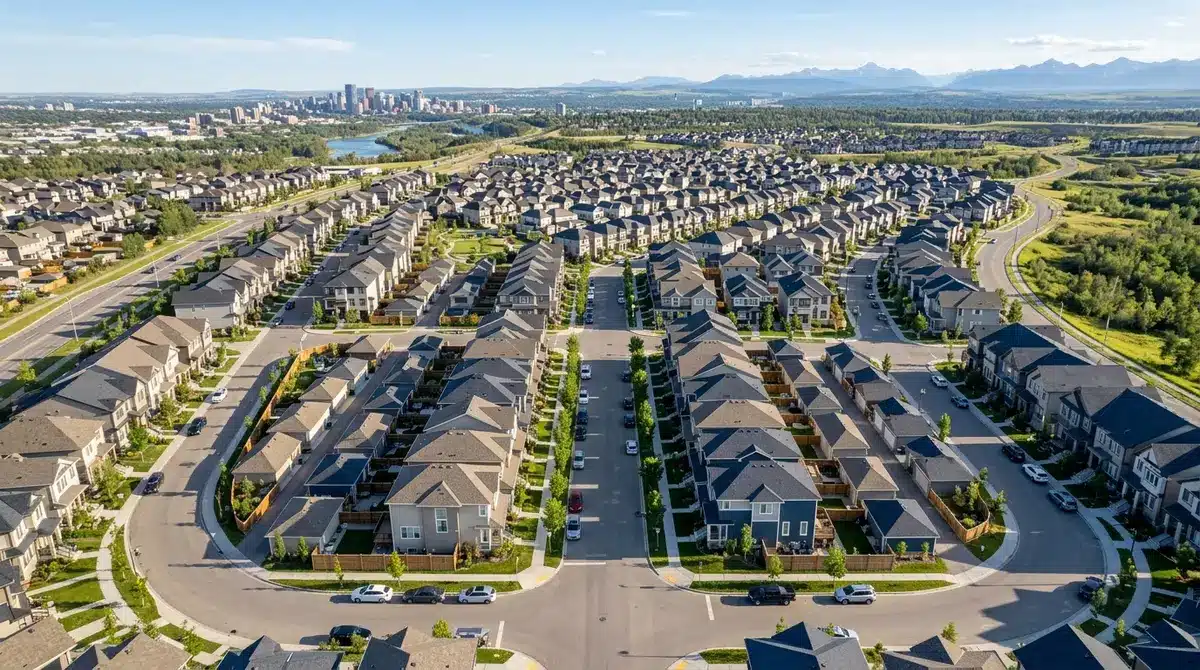
The regulations governing property dimensions for new builds in Alberta are dictated by the provincial Municipal Government Act but strictly enforced through local municipal zoning bylaws. In 2026, major urban centers like Calgary and Edmonton have largely abolished traditional single-family zoning minimums, allowing lot widths as narrow as 7.5 meters for detached homes and heavily promoting zero lot line configurations. For rural and unserviced areas, minimum parcel sizes remain significantly larger, typically requiring at least 2.0 acres to accommodate private septic and well systems safely.
Key Takeaways
- Urban Densification: Major Alberta cities have updated 2026 zoning bylaws to permit narrower frontages, dropping minimum widths to 7.5 meters in many residential zones.
- Zero Lot Lines: Building directly on the property boundary is increasingly standard, requiring a mandatory 1.5-meter maintenance easement on the adjacent parcel.
- Rural Requirements: Unserviced county lots require a minimum of 2.0 to 4.0 acres to meet environmental regulations for water and waste management.
- Lot Coverage Limits: Most urban municipalities cap total building footprints at 42% to 45% of the total parcel area to ensure adequate drainage.
- Subdivision Complexity: Splitting existing parcels requires a Development Permit, a Real Property Report (RPR), and strict adherence to local Floor Area Ratio (FAR) guidelines.
The Evolution of Property Dimensions in Alberta
The landscape of residential real estate development has shifted dramatically over the past decade. Driven by rapid population growth and a mandate to curb urban sprawl, provincial and municipal authorities have fundamentally altered how land is divided and utilized. According to the Canada Mortgage and Housing Corporation (CMHC), urban density initiatives have reduced average new parcel sizes in Alberta by 18% since 2022.
This reduction is not merely a developer preference; it is a legislated reality. Municipalities are actively rewriting their rulebooks to encourage “missing middle” housing, infill development, and higher-density subdivisions. For prospective buyers and investors, understanding these spatial constraints is critical when choosing a parcel for your new build.
As Dr. Sarah Jenkins, Urban Economics Chair at the University of Alberta, explains: “The shift toward micro-parcels and relaxed boundary constraints is the most significant evolution in provincial land use since the 1970s. By eliminating exclusionary single-dwelling minimums, municipalities are forcing the market to prioritize spatial efficiency over sprawling footprints.”
Municipal Zoning Bylaws: Calgary vs. Edmonton
While the Municipal Government Act (MGA) provides the overarching legal framework, specific dimensional requirements are localized. The two largest cities have taken aggressive, albeit slightly different, approaches to their 2026 planning frameworks.
Calgary’s R-CG Zoning and Density Push
Calgary’s blanket rezoning initiatives have made R-CG (Residential – Grade-Oriented Infill) the new baseline for many established and developing neighborhoods. This zoning allows for rowhouses, semi-detached, and detached homes on significantly smaller footprints. Standard side setbacks have been reduced to 1.2 meters, and frontage requirements have been slashed to accommodate higher density.
According to Marcus Thorne, Senior Planner at the Calgary Metropolitan Region Board: “The R-CG framework was designed to remove the bureaucratic friction from infill development. We are seeing a 60% increase in development permits for narrow-lot configurations compared to five years ago.”
Edmonton’s Zoning Bylaw Renewal
Edmonton recently overhauled its entire planning rulebook with the Zoning Bylaw Renewal Initiative. The new RS (Small Scale Residential) zone consolidates multiple older categories, allowing for greater flexibility. In Edmonton, a standard detached house can now be built on a parcel as small as 250 square meters, provided the design meets strict lot coverage and height restrictions.
| Municipality | Primary Residential Zone | Minimum Width | Maximum Lot Coverage |
|---|---|---|---|
| Calgary | R-CG (Grade-Oriented) | 7.5 meters | 45% (varies by context) |
| Edmonton | RS (Small Scale) | 7.5 meters | 42% – 45% |
| Red Deer | R1 (Standard) | 9.0 meters | 40% |
Understanding Zero Lot Line Developments
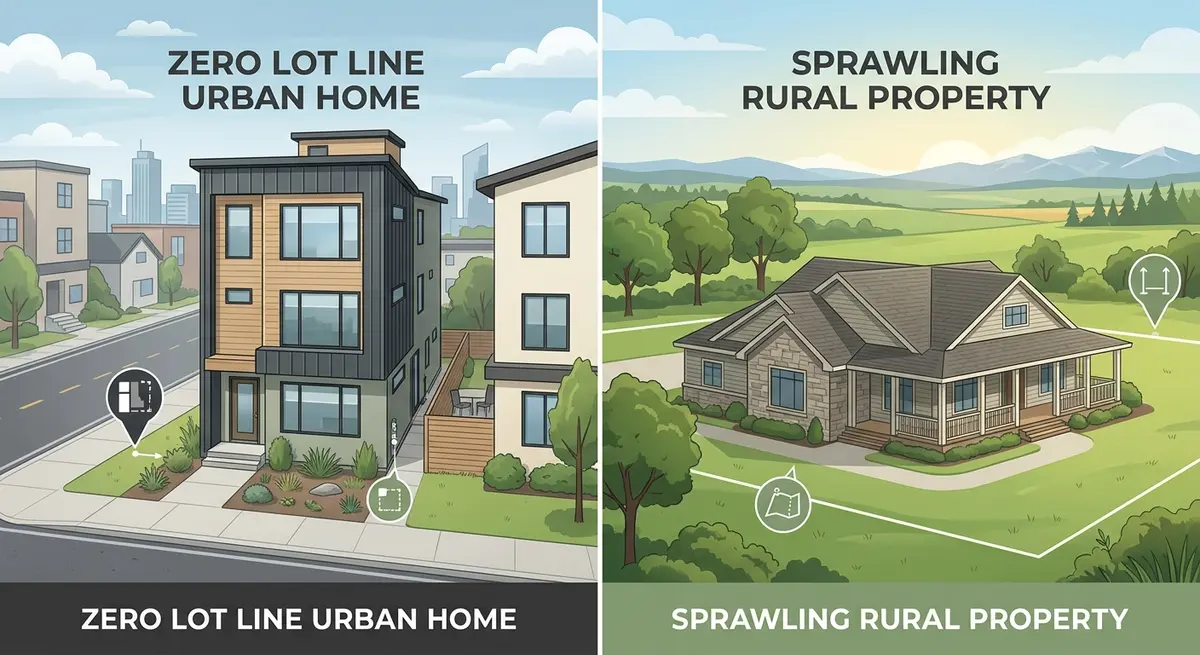
One of the most prominent trends in master-planned development communities across the province is the zero lot line home. In this configuration, one side of the house is built exactly on the property boundary, maximizing the usable yard space on the opposite side.
However, this requires a strict legal framework to function. A mandatory 1.5-meter maintenance easement is registered on the title of the neighboring property. This easement ensures that the homeowner has legal access to the adjacent land for exterior maintenance, roof repairs, and drainage management. Eavestroughs must be specially designed to prevent water runoff from crossing the property line, a critical factor when evaluating landscaping compliance requirements.
Elena Rostova, Director of Housing Policy at the Canadian Urban Institute, notes: “The financial viability of modern subdivisions relies heavily on maximizing the floor area ratio within a shrinking footprint. Zero lot lines are the architectural compromise that allows single-family living to persist in high-density urban environments.”
Subdivision Rules and Rural Property Regulations
The rules change drastically once you leave the city limits. For those exploring rural versus urban construction dynamics, county regulations prioritize environmental sustainability and infrastructure capacity over density.
In municipalities like Rocky View County or Strathcona County, unserviced land—meaning parcels without access to municipal water and sewer lines—must be large enough to safely house a private water well and a septic field. Provincial health regulations mandate strict separation distances between these systems. Consequently, the absolute minimum size for an unserviced rural parcel is typically 2.0 acres, with many counties enforcing 4.0-acre minimums depending on soil permeability and watershed protection zones.
How to Navigate Municipal Development Approvals
Whether you are a developer looking to subdivide or a buyer planning a custom build, navigating the regulatory approval process requires a methodical approach. Follow these essential steps to ensure compliance with local dimensional bylaws:
- Verify the Land Use Designation: Before purchasing land, consult the municipal zoning map to confirm the exact designation (e.g., RS, R-CG, R1). This dictates the absolute minimum frontage, area, and allowable building types.
- Commission a Real Property Report (RPR): Engage an Alberta Land Surveyor to draft an RPR. This legal document maps the exact boundaries, existing structures, and registered utility rights-of-way.
- Calculate Floor Area Ratio (FAR) and Coverage: Ensure your architectural plans do not exceed the maximum allowable lot coverage (typically 42% to 45%). This calculation must include attached garages and covered decks.
- Address Servicing and Utilities: Confirm that the parcel has adequate access to municipal services. If subdividing, you are responsible for the utility hookup process, which can involve significant trenching and infrastructure fees.
- Submit a Development Permit Application: Present your site plan, elevations, and RPR to the municipal planning department. Once the Development Permit is approved, you may proceed to apply for specific Building Permits.
Impact on Property Value and Construction Costs
The dimensions of your parcel directly influence both land acquisition costs and the overall budget of the build. As urban land becomes scarcer, the price per square foot of raw land has surged. However, by allowing narrower frontages, municipalities have enabled developers to offer lower absolute land prices per home, keeping new builds accessible.
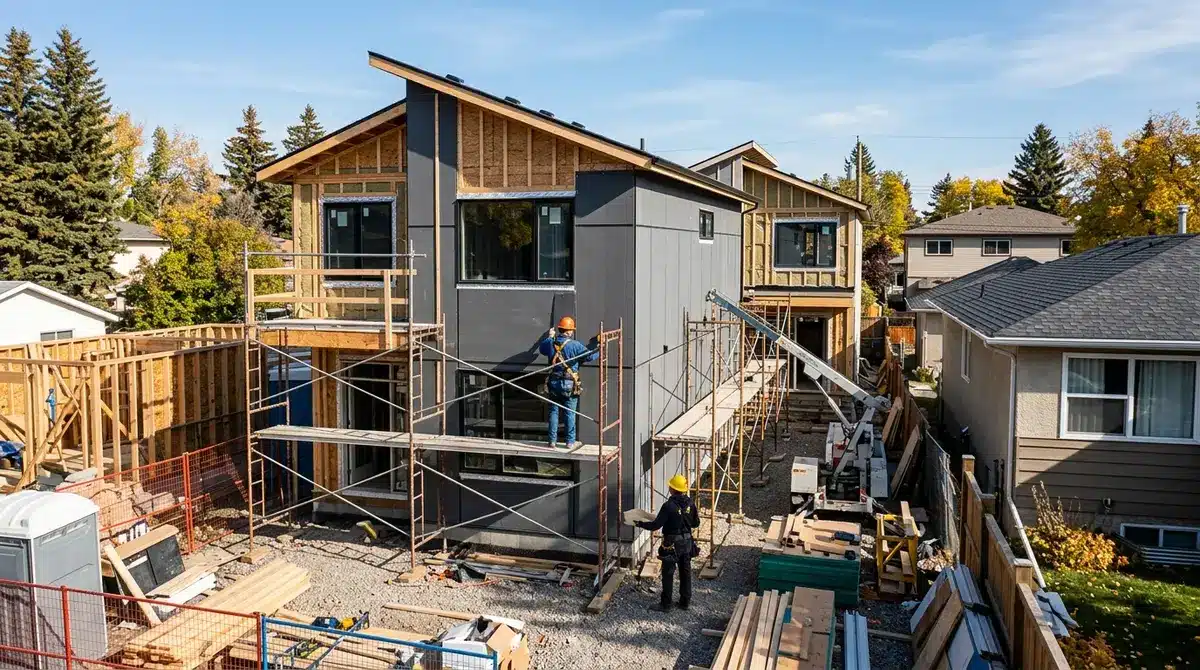
From a construction standpoint, narrow and zero lot line configurations often require specialized engineering. Limited side access can complicate the delivery of materials and the operation of heavy machinery, occasionally driving up construction material expenses due to increased labor time. Furthermore, fire code regulations mandate specialized fire-rated drywall and non-combustible exterior cladding on walls built close to property boundaries, adding to the structural budget.
Edge Cases: Corner Parcels and Irregular Frontages
Not all parcels are perfect rectangles. Cul-de-sacs, curved roads, and corner properties introduce complex edge cases into zoning compliance. For pie-shaped parcels, municipalities typically measure the minimum lot width at the front setback line rather than the street curb. This allows homes to be built on parcels that appear incredibly narrow from the sidewalk but widen significantly toward the rear.
Corner properties face dual-frontage regulations. Because they flank two public roads, they are subject to strict side-yard setbacks to maintain traffic sightlines and pedestrian safety. This often reduces the buildable envelope, forcing buyers to carefully consider their semi-detached or detached housing goals to ensure the desired floor plan fits within the restricted footprint.
Frequently Asked Questions (FAQ)
What is the absolute minimum lot size for a house in Alberta?
In major urban centers like Edmonton and Calgary, the minimum width for a detached home can be as narrow as 7.5 meters (approximately 24.6 feet) under 2026 zoning bylaws. The total area can be as small as 250 square meters, provided all setback and coverage rules are met.
Can I subdivide my existing property to build a second home?
Yes, property subdivision is highly encouraged in major Alberta cities to promote infill density. However, your existing parcel must be wide enough to accommodate two legally compliant frontages, and you must secure a subdivision approval and Development Permit from the municipality.
What are the standard setback requirements for a new build?
Standard urban setbacks typically require a minimum of 4.5 to 6.0 meters for the front yard and 1.2 meters for side yards. Rear yard setbacks usually demand at least 7.5 meters, though these figures vary based on the specific neighborhood zoning designation.
How do zero lot line easements work?
A zero lot line allows a home to be built directly on the property boundary. To facilitate maintenance, a 1.5-meter legal easement is registered on the neighboring property’s title, granting the homeowner access to repair their exterior walls and roof.
Are rural property size rules different from city rules?
Yes, rural rules are vastly different. Unserviced rural parcels typically require a minimum of 2.0 to 4.0 acres to ensure there is enough land to safely install and separate a private water well and a septic field according to provincial health codes.
What is the maximum lot coverage allowed in Alberta?
Most urban municipalities cap total building coverage at 42% to 45% of the total parcel area. This percentage includes the primary residence, attached garages, and any covered accessory structures to ensure adequate rainwater drainage.
Conclusion
Navigating the regulations governing property dimensions in Alberta requires a deep understanding of both provincial legislation and localized municipal bylaws. As we move through 2026, the push for urban densification continues to reshape the real estate landscape, making narrow parcels and zero lot line configurations the new standard in city limits. Conversely, rural builds remain bound by strict environmental spacing requirements. Whether you are an investor planning an infill project or a family looking to build a custom home, understanding these spatial rules is the first step toward a successful build.
If you need expert guidance navigating zoning bylaws, securing permits, or finding the perfect parcel for your next project, our team is here to help. Get in touch with our team today to start planning your Alberta new home construction journey.


