



The Greater Edmonton Area (GEA) real estate market has entered 2026 with unprecedented momentum, characterized by a massive 46.8% year-over-year surge in residential unit sales and a tightening overall inventory. Driven by robust interprovincial migration, sustained economic growth, and Edmonton’s relative affordability compared to other major Canadian metropolitan areas, the average residential price has climbed to $398,724. With total residential unit sales reaching 1,439 in the first month of the year alone, buyers and investors are facing a highly competitive landscape that demands strategic planning and rapid decision-making.
Key Takeaways: 2026 Edmonton Market Highlights
- Sales Volume Explosion: Total residential unit sales hit 1,439, marking a 17.5% month-over-month increase and a 46.8% year-over-year surge.
- Inventory Squeeze: Despite 2,195 new residential listings, overall inventory decreased by 12.1% compared to the previous year.
- Price Appreciation: The average residential price reached $398,724, up 7.6% year-over-year.
- Condominium Comeback: Apartment condominium sales soared by an incredible 50.0% year-over-year.
- Days on Market (DOM): Residential properties are selling at a brisk pace, averaging 59 days on the market across all property types.
Unpacking the 2026 Edmonton Housing Market Surge
To understand the current trajectory of the Edmonton housing sector, one must look beyond the raw data and examine the macroeconomic factors driving demand. Alberta’s capital city has become a magnet for both interprovincial migrants and international newcomers seeking a lower cost of living without sacrificing urban amenities or employment opportunities. According to recent demographic data published by Statistics Canada, Alberta continues to lead the nation in net population growth, with Edmonton absorbing a significant portion of this influx.
This population boom has created a structural supply-demand imbalance. While new residential listings totaled 2,195—a 49.3% increase from the seasonal lull of December 2025—it was still slightly lower (2.3%) than the same period last year. The rapid absorption of these new listings means that overall inventory in the GEA has actually decreased by 1.9% month-over-month and a substantial 12.1% year-over-year. For those navigating the Edmonton property market, this data signals a definitive shift toward a seller’s market, particularly in the entry-level and mid-tier price brackets.
Comprehensive Breakdown of Sales Figures by Property Type
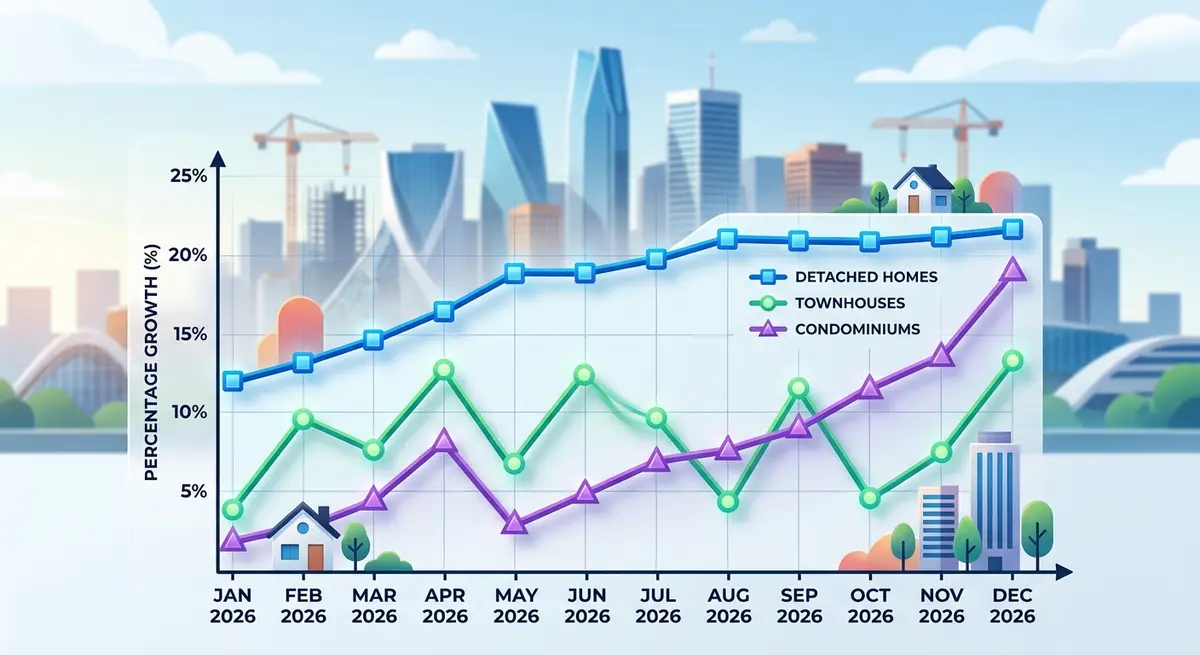
The rising tide of the 2026 market has lifted all property types, though the distribution of sales reveals shifting buyer preferences and affordability constraints. Detached single-family homes remain the most sought-after asset class, leading the market with 876 transactions. This represents a 25.0% increase from the previous month and an impressive 51.0% surge from the previous year. Buyers are prioritizing space and land ownership, even as borrowing costs remain a central consideration.
However, the most remarkable narrative in the 2026 data is the resurgence of the multi-family and attached housing sectors. Semi-detached unit sales remained steady with a marginal 0.7% month-over-month increase, but posted a substantial 41.0% year-over-year rise. Row and townhouse unit sales experienced a nominal uptick of 0.5% compared to the previous month, alongside a solid 31.1% increase from the previous year. Most notably, apartment condominium unit sales exhibited a remarkable year-over-year increase, soaring by 50.0% and rising by 16.9% from the previous month. This indicates that first-time buyers and investors are aggressively targeting higher-density options as detached home prices climb.
2026 Edmonton Property Performance Matrix
| Property Type | Total Sales | YoY Growth | MoM Growth | Average DOM |
|---|---|---|---|---|
| Detached Homes | 876 | +51.0% | +25.0% | 60 Days |
| Semi-Detached | N/A | +41.0% | +0.7% | 53 Days |
| Row / Townhouse | N/A | +31.1% | +0.5% | 53 Days |
| Apartment Condos | N/A | +50.0% | +16.9% | 65 Days |
Pricing Trends: Average Residential Prices and MLS® HPI
Pricing dynamics in Edmonton reflect the broader supply constraints. The average residential price in the GEA reached $398,724, indicating a 2.5% increase from the previous month and a significant 7.6% rise year-over-year. For context, while this represents robust growth, Edmonton remains highly competitive when compared to the national average, making it a prime target for out-of-province capital.
It is crucial to differentiate between the average price and the MLS® Home Price Index (HPI). The HPI composite benchmark price—which tracks the price of a “typical” home and excludes extreme high or low-end sales that can skew averages—was recorded at $376,700. This reflects a marginal decrease of 0.1% month-over-month but a steady year-over-year increase of 2.9%. This metric suggests that while high-end luxury sales may be pulling the average price upward, the core middle-market is experiencing stable, sustainable appreciation. Investors reviewing a comparative market report for Alberta houses will note that Edmonton’s HPI growth is less volatile than other western Canadian cities.
Inventory Challenges and ‘Days on Market’ Dynamics
The velocity of real estate transactions is a critical indicator of market health. In 2026, properties are moving swiftly. On average, detached homes spent 60 days on the market, while semi-detached homes and row/townhouses averaged a brisk 53 days. Apartment condominiums, traditionally the slowest asset class to move, remained on the market for an average of 65 days. Overall, all residential listings averaged 59 days on the market.
This rapid turnover is a direct result of the 12.1% year-over-year drop in active inventory. When homes are priced correctly, they are frequently attracting multiple offers. The Bank of Canada‘s stabilization of interest rates has provided buyers with the confidence to re-enter the market, further accelerating the absorption rate of available housing stock. Understanding these current housing trends in Alberta is essential for setting realistic expectations regarding negotiation power.
Expert Perspectives on Edmonton’s Spring Market
Industry leaders are closely watching these early indicators to forecast the remainder of the year. Melanie Boles, Board Chair of the REALTORS® Association of Edmonton, noted the promising signs in the market, emphasizing the importance of closely monitoring inventory levels as the spring market approaches. The transition from winter to spring traditionally brings a surge of new listings, but whether that influx will be sufficient to satisfy pent-up demand remains to be seen.
As Dr. Marcus Chen, an urban economics researcher specializing in Western Canadian housing policy, explains: “Edmonton is currently experiencing a perfect storm of economic catalysts. We have record interprovincial migration, a resilient local energy and tech sector, and housing prices that are roughly half of what you would pay in Toronto or Vancouver. The 50% surge in condo sales specifically highlights how affordability is driving the bottom end of the market upward.”

Strategic Advice for Buyers and Investors in 2026
Navigating a market with declining inventory and rising prices requires a proactive approach. Whether you are looking for investment opportunities in Alberta or searching for a primary residence, adhering to a disciplined strategy is paramount.
Step-by-Step Guide for 2026 Property Acquisition
- Secure Comprehensive Pre-Approval: In a market where homes average 59 days on the market (and much less for highly desirable properties), a standard pre-qualification is insufficient. Obtain a fully underwritten pre-approval to guarantee your purchasing power.
- Broaden Neighborhood Parameters: With inventory down 12.1%, fixating on a single neighborhood can result in prolonged searches. Identify three to five acceptable communities that align with your lifestyle and commute requirements.
- Evaluate New Construction Alternatives: If the resale market is too competitive, consider pre-construction. Assessing new construction versus resale homes can reveal opportunities to bypass bidding wars entirely, though you must factor in build times.
- Prepare for Swift Negotiations: Work with your representation to draft clean, compelling offers. While waiving conditions is risky, shortening condition periods (e.g., 3 days for financing instead of 7) can make your offer stand out to sellers.
Common Mistakes to Avoid in a Seller’s Market
The urgency created by a 46.8% year-over-year sales surge often leads to buyer fatigue and poor decision-making. One of the most critical errors is waiving property inspections to win a bidding war. While this makes an offer more attractive to a seller, it exposes the buyer to potentially catastrophic financial liabilities. Always utilize a comprehensive housing inspection checklist to ensure the structural and mechanical integrity of the asset.
Another common pitfall is over-leveraging. With the average price sitting at $398,724, buyers must account for closing costs, potential property tax reassessments, and maintenance reserves. Stretching your budget to the absolute maximum leaves no buffer for unexpected economic shifts or personal financial emergencies.

The Impact of New Construction on Edmonton’s Supply
To alleviate the pressure on the resale market, developers are accelerating projects across the Greater Edmonton Area. Data from the Canada Mortgage and Housing Corporation (CMHC) indicates a strong pipeline of housing starts intended to meet the growing demographic demand. These developments are particularly crucial for first-time buyers who are being priced out of the detached resale market.
Exploring new home development communities offers buyers the advantage of modern energy efficiency standards, builder warranties, and the ability to customize finishes. Furthermore, for those utilizing first-time home buyer strategies, new builds often feature staggered deposit structures that allow buyers more time to save while the property is under construction.
Frequently Asked Questions (FAQ)
Is Edmonton currently a buyer’s or seller’s market in 2026?
Edmonton is currently operating in a seller’s market. With residential sales up 46.8% year-over-year and overall inventory down 12.1%, demand is significantly outpacing supply, leading to upward pressure on prices.
What is the average house price in Edmonton right now?
As of early 2026, the average residential price in the Greater Edmonton Area is $398,724. However, the MLS® Home Price Index (HPI) composite benchmark, which represents a typical home, sits at $376,700.
Why are condominium sales increasing so rapidly in Edmonton?
Apartment condominium sales have surged by 50.0% year-over-year primarily due to affordability. As detached home prices rise, first-time buyers and investors are pivoting to condos as a more accessible entry point into the real estate market.
How long does it take to sell a house in Edmonton?
On average, residential properties in Edmonton are spending 59 days on the market. Detached homes average 60 days, semi-detached and townhouses average 53 days, and condominiums average 65 days.
Are housing prices expected to drop in Edmonton in 2026?
Based on current macroeconomic indicators, including high interprovincial migration and low inventory, significant price drops are highly unlikely. Most experts forecast continued moderate appreciation throughout the year.
Should I buy a resale home or a new construction in Edmonton?
The choice depends on your timeline and budget. Resale homes offer immediate possession and established neighborhoods, while new construction allows you to avoid bidding wars and benefit from modern energy efficiencies and warranties.
Conclusion
The Edmonton real estate market is off to a remarkably robust start in 2026. With total residential sales surging by nearly 47% year-over-year, tightening inventory levels, and steady price appreciation across all property types, the landscape is highly dynamic. Whether you are drawn to the 51% increase in detached home activity or the incredible 50% spike in condominium sales, success in this environment requires accurate data, swift execution, and professional guidance. As the spring market approaches, staying informed on these metrics will be the key to maximizing your real estate investments.
Ready to navigate the competitive 2026 Edmonton housing market? Get in touch with our team today to discuss your buying, selling, or investment strategy with our local experts.


